A never before seen extended video snippet of Dylan behind Blackjack pizza which Sue is watching with a forlorn expression while presenting at the Breakfast of Champions. [video] (Who wants to capture this entire snippet? ;))


Yes, the Ever-lasting contrast. Since existence has known, the 'fight' between good & evil has continued. Obviously, this fight can never end. Good things turn bad, bad things become good. My fav. contrasting symbol, because it is so true & means so much – the battle between good & bad never ends… Here we ponder on the tragedy of Dylan Klebold.
A never before seen extended video snippet of Dylan behind Blackjack pizza which Sue is watching with a forlorn expression while presenting at the Breakfast of Champions. [video] (Who wants to capture this entire snippet? ;))


Sue Klebold shares story of tragedy at annual Breakfast of Champions
“
The education system has to be a big part of how we build wellness and resiliency in our youth
” – Sue Klebold
Sue Klebold talked about her life after the 1999 Columbine High School shooting and how it’s led her to become a passionate mental health advocate at this year’s Breakfast of Champions event on Wednesday, April 26th.
More than 1,200 local community leaders and mental health advocates attended the event, which took place on April 26 at London Convention Centre.
St. Joseph’s Health Care Foundation, in partnership with the Canadian Mental Health Association (CMHA) Middlesex, hosted the breakfast.
“Some of the most spectacular work around mental health comes from those with an idea and a passion for making the community better, safer and healthier for all of us,” said Dr. Steven Harrison, CEO of the Canadian Mental Health Association Middlesex. “CMHA Middlesex is proud to participate in the Breakfast of Champions where we recognize the region’s true champions of mental health — this year a recent university graduate, a paramedic, two volunteers, a police service, a physician and an expressive arts program — who are all creating change in significant and meaningful ways.”
In a one-on-one conversation with CBC News Host Heather Hiscox, Klebold shared her journey as a mother trying to come to terms with the knowledge of her son’s role in Columbine, and the realization of his struggle with mental illness.
She also shared invaluable insights from her experience in an effort to help other families recognize when a child is in distress.
Afterwards Klebold joined local experts and mental health advocates for a panel discussion on youth mental health, which included Lori Hassall, Dr. Elizabeth A. Osuch, Dr. Javeed Sukhera, Scarlet Davidson and Jesse House.
“This breakfast has become an important event for mental health care, advancing the public dialogue as a way to demystify how we think and talk about mental illness,” said Michelle Campbell, President and CEO, St. Joseph’s Health Care Foundation. “It also enables us to invest in transformative mental health care that would otherwise not be possible”
The 11th annual Breakfast of Champions also recognized several individuals and organizations that have made significant contributions to mental wellness in the community through the Champion of Mental Health Awards.
Todd Devlin and Riley Doan received the individual award for their efforts in bringing the Defeat Depression Campaign to London.
London Police Service received the organization award for the work they are doing to support the well being of their members and to enhance police and community response to mental health and addictions crisis in the community.
The full list of nominees for the CMHA Champion of Mental Health Awards includes:
Individuals
[video] – Including a longer vid of Dylan behind Blackjack parking lot !!! 🙂
Sue is watching it. 😦
Funny you should ask.. 😉
Sue will be presenting as Keynote Speaker next month!
Annual Pastoral Care Conference MetroHealth Medical Center Scott Auditorium
May 18 and 19, 2017 Cleveland, Ohio 44109 (her old state!, Columbus, OH to be exact. I bet she’ll be visiting relatives while there.)

Sue presents May 19th from 2:30 – 4:00 pm
Rejection, Ostracism and Social Exclusion: Causes and Consequences
May 18-19, 2017MetroHealth Medical Center |
Scott Auditorium
2500 MetroHealth Drive
Cleveland, Ohio 44109
Registration Fee (after May 5, 2017)
$175
$160 Discounted Rate for MH employees
Conference fee includes parking, refreshments, lunch and materials.
Registration deadline is May 12, 2017.
This conference is for social workers, nurses, marriage and family therapists, psychologists, counselors, clergy, physicians, chemical dependency professionals, funeral directors and educators.
Keynote Speakers |
C. Nathan DeWall, PhD
Louise Hawkley, PhD
Sue Klebold, MA
Ethan Kross, PhD
Kipling D. Williams, PhD
Conference participants will be able to:
I believe Dylan is wearing the exact same pair of light blue jeans – slim cut / tapered ankle – in both of these video productions spanning a year apart. You can literally see his sudden weight loss as the jeans look completely different on him. They are hanging off his legs in March ‘99 just one month before the massacre.
His jeans still fit his legs well with only a slight bit of sagging in the pant leg. You can still make out the muscles of his thighs. They still hug around his tiny ass just enough that he actually has one.


Flash forward 6.5 months..
Dylan’s pants are sagging out from his non-existent thighs and hanging and draping off in puddles on his backside. No longer a hint of an ass. The fabric is collecting in pools around his calves.


The event, “Steps Toward a Safer Tennessee,” will be April 19 2017 at Trevecca Community Church, 335 Murfreesboro Pike in Nashville.
Breakout sessions on safety planning and violence prevention are also planned.
This is the day before Columbine. Traveling and speaking to others will probably help keep her mind from dwelling too heavily on 18 years ago. 😦
What
was he like as a kid – what was your son like?
“That’s
funny you should mention that I was just looking at pictures this
morning. He was an adorable child – he was the kind of child that
every parent wishes they could have. He was..um, you know we called
him our ‘Golden Boy’. He was loving, playful, adorable, cute – he
looked like cupid – he looked like one of those Renaissance
paintings of a cupid. He had thick curly blonde hair and blue eyes –
and he was extremely bright. The thing that I adored about Dylan, I
think more than anything else, was how it tickled me- how easily he’d
learned. This child was doing equations with number magnets on the
refrigerator when he was an early three year old and he was still
wearing a diaper at night. He was just so interested in numbers and
letters and reading. He was really, from a very young age, very
scholarly. He wanted to learn things. He could read books.like hard
cover books like Stuart Little or Charlotte’s Web silently to
himself. And when he was in kindergarten and he entered kindergarten
a year older, a year ahead of everyone else so he was only four years
old when he could read like that. So, he was a very extremely bright
child but he was a very normal child in terms of his social
interactions. My family albums are filled with pictures of him doing
what healthy little boys do he was in cub scouts, he built snowmen,
he carved pumpkins. I mean, this is what our family album looks
like.”
Jefferson Public Radio • MAR 21, 2017
“I always dream about Dylan. I had a dream about him a couple of nights ago where I was in a van and a policemen was driving this van. I looked out the window and Dylan who was about four years old in the dream was with a little boy, a friend, and the van was driving away and I looked down, and Dylan was chasing the van trying to catch up to me. And the policeman who was driving the van slammed on the breaks, got out of the car, threw both of these little boys into a dumpster, and slammed the lid down and locked it so they couldn’t get out. You know, I’m always having ‘drama queen’ dreams, always crying and pounding things in my dream. But in that dream, I’m in this van trying to get to my son and he’s just been locked away. You can get the full symbolism here. The front door of the wall of the bin opened and Dylan ran to the van where I was pulling away and he chased this van. And I opened the door, and I grabbed – I pulled him in with me. When he got with me into this van, he was telling me that he was hurting. ‘I’m hurting; I am sad’. And I looked at his face, and he had this terrible – these spiky sores were coming out of his face. And I was trying to fix him and put lotion on him and he said “It can’t help, it hurts too much for you to touch these.” And ah, in this dream I was – all I could do was to hug him and let him rest his head on my chest and then I woke up..”
–Sue’s dream, excerpt from her Reaching for Hope speech, Feb 16, 2017
Sue is really engaging and especially really thoughtful, attentive and receptive to people’s questions and comments at the end of this particular intimate speech given in a small conference room. Seems this casual setting is easier for her to manage than the TEDMED speech where she didn’t have a podium to hold on to for a bit of security while placing herself in the seat of judgment in front of an audience. Another highlight was near the end, when a guy mentioned that he too had been a gifted kid that was severely bullied in school dealing with homicidal thoughts poses important questions to Sue as yet another could-have-been Dylan.
I must say that I found the nose level of the audience offensive and it seemed strange that the event planners decided to allow the audience to dine while listening to Sue’s speech. Plates were clattered and people were milling in and out of the room and a couple of times, they walked right in front of Sue as they were likely making a restroom break. Very distracting and disrespectful. In my opinion, the meal should’ve been arrange after her talk so that the audiences’ full, undivided attention could’ve been given to her as she was imparting her tragic happening and lessons learned from it.
Enjoy!

By STEVE KRASKE & CLAIRE TADOKORO • FEB 6, 2017
kcur.org 89.3
Sue Klebold writes about her relationship with her son, Dylan, in a new memoir, ‘A Mother’s Reckoning.’ He was one of two shooters at Columbine High School on April 20, 1999.
Valentine’s Day is next week, and it can be either the greatest or the worst holiday of the year. Today, we get some perspective on the nature of romantic love, and try to reconcile two different ways of thinking about it. Then, Sue Klebold recollects the morning her son, Dylan, and Eric Harris opened fire at Columbine High School. She speaks of the aftermath of the shooting, and her advocacy for mental health and suicide prevention.
[Source]

January 30, 1998 ~ 19 years ago on this night ~ January 30, 2017
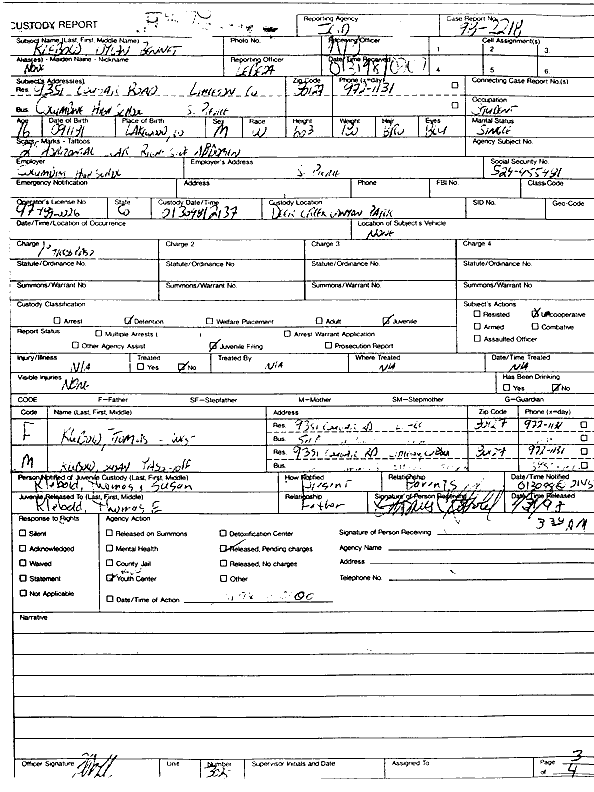
Dylan was having a okay, ordinary day at school – even doing an Interview for the Rebel News Network in the afternoon (interview clip) – but by 8 pm that evening, his life had changed for ever. All it takes is one day, one choice, one event that can alter destiny forever like the abrupt switch of a train on a different set of tracks. It was the day that a bright, clean cut boy with so much future potential had made the wrong choice and had in effect, fallen from grace. The disappointment in his parents eye’s reflecting back at himself upon his arrest at the police station. Before, he could do no wrong..but now? He felt his life a fuck up and with one major slip up, this was now a nail on the coffin to confirm it.
The event wounded and mortified him deeply.
From that day forward, he would embark on the beginning of his end as he slowly eroded inside himself in silence. It was the beginning of his downward spirals decent as a troubled juvenile on a crash course with an infamous destiny set to self destruct.
This is the tale of..
The next incident during Dylan’s junior year was the most catastrophic of all.
On January 30, a few days after Dylan scratched the locker at school, he and Eric were arrested for breaking into a parked van and stealing electronic equipment.
Dylan had agreed to go with Zack to an activity at his church that night, and the two of them planned to come back to our house for a sleepover afterward. Tom and I were listening to music together in the living room when the phone rang around 8:30 p.m. It was Zack’s dad, audibly upset. Zack had quarreled with his girlfriend and left the event with her. He’d gotten hurt, possibly after stepping out of a moving car, and wasn’t making much sense. It was all very confusing, but Zack’s parents wanted us to know the plan had changed. Dylan wasn’t with Zack; he’d left the church with Eric.
I thanked Zack’s dad for the update and immediately called the Harrises, who were as concerned as we were not to know where the boys were. Both sets of parents promised to get in touch immediately if we heard from the kids. Within minutes, our phone rang again. It was the county sheriff. Dylan and Eric had been arrested for criminal trespass.
Tom and I drove to the local sheriff’s auxiliary office; the Harrises were already there. The offenses included First Degree Criminal Trespass and Theft, both of which were felonies, and Criminal Mischief, a misdemeanor.
My mouth hung open when I heard how serious the charges were. I could not believe that our Dylan, who had never done anything really wrong in his life, could do something so terrible. This was the kind of trouble that might seriously impact his future. Neither of us had ever been arrested, so we called one of our neighbors, a lawyer, for advice. He told us Dylan should “spill it,” tell the complete truth. Before he hung up, he reassured us. “Boys do dumb stuff. He’s a
good kid. He’ll be okay.”
We waited for what felt like an eternity. Mrs. Harris wept. Then a deputy followed the boys through the substation office door. I practically threw up when I saw Dylan paraded past me in handcuffs.
We waited hours to learn whether our children would be sent to a detention facility or allowed to return home. Finally, the officer who arrested them recommended they be considered for a Diversion program, an alternative to jail for first-time juvenile offenders accused of minor crimes. The program would provide supervised counseling and community service, and allow
the boys to avoid criminal charges and placement in a detention facility. The boys were released into our care.
Our drive home was silent, as all three of us contended with our various emotions: fury, humiliation, fear, and bewilderment. We arrived, emotionally and physically exhausted, around four o’clock in the morning. Tom and I needed to discuss how we wanted to respond. There would be consequences, we told Dylan, but we would talk about them after we got some rest. Exhausted as I was, the sun was up before I was able to close my eyes and sleep.
Tom woke before I did. When Dylan got up, they took a long walk. Afterward, Tom told me Dylan had been very, very angry—at the situation, the cops, his school, the unfairness of life. He was so angry that he didn’t seem to accept or acknowledge the wrongness of what he had done.
I was still mad myself, and didn’t want to talk to Dylan until I could be calm. Later in the day, the two of us sat together on the stairs. The master bedroom was on the ground floor, and Dylan’s room was upstairs, so we often sat on the stairs between them to talk. I recounted our conversation verbatim in my journal that night, and have relived it in my mind countless times since his death.
I began, “Dylan. Help me understand this. How could you do something so morally wrong?” He opened his mouth to answer, and I cut him off. I said, “Wait. Wait a minute. First, tell me what happened. Tell me everything, right from the beginning.”
He told me the story of his bizarre evening. After Zack left the church, he and Eric decided to go light some fireworks, so they drove to a parking area not far from our house where recreational cyclists stowed their cars while they biked the scenic canyon road. There, they saw an empty commercial van parked in the darkness. They saw electronic equipment inside. The van was locked. They banged on the window and tried to open it. Dylan rationalized this by
noting the van was deserted. When the window did not open, they broke it with a rock.
I asked Dylan if breaking the window was Eric’s idea. He said, “No. It was both of us. We thought of it together.”
They took the equipment and drove to a secluded spot close by. Minutes later, a deputy drove by and saw the damaged van. He found the two boys in Eric’s car with the equipment a short distance down the road. As soon as the officer approached the car, Dylan confessed.
When I’d heard the whole story, I asked my question again. “You committed a crime against a person. How could you do something so morally wrong?” His answer shocked me. He said, “It was not against a person. It was against a company. That’s why people have insurance.” My jaw dropped. I cried out, “Dyl! Stealing is a crime against a person! Companies are made up of people!” I tried to appeal to his sense of reason. “If one of our renters decided to steal a light
fixture from one of our apartments, would it be a crime against a rental company, or against us?”
Dylan relented, “Okay, okay. I get the point.” But I didn’t stop. I explained that the owner of the van would have to pay a deductible to the insurance company. “There’s no such thing as a victimless crime, Dylan.” I’d heard a story about a programmer who figured out a way to siphon tiny, nearly untraceable amounts of money from calculations that left an odd penny. “Before long, you’ll know enough to do something similar,” I told him. “Do you think that’s ethical?” He said he knew it was not, and assured me he’d never do anything of the kind.
What he’d done was wrong, and I wanted him to know it. Appealing to his empathy, I asked him how he’d feel if someone stole from him. “Dylan, if you follow no other rules in your life, at least follow the Ten Commandments: thou shalt not kill, thou shalt not steal.” I paused to consider which of the other commandments might have relevance, and then decided to stop
haranguing him. “Those are rules to live by.”
He said, “I know that.”
We sat in silence for a little while. Then I said, “Dyl, you’re scaring me. How can I be sure you’ll never do such a thing again?” He said he didn’t know, and seemed frightened to learn he could do something so bad on an impulse. He was obviously miserable. I felt no anger at that point, only compassion.
Before we stood, I told him he had broken our trust. We would be watching him more closely, and his activities would be restricted. He complained it wasn’t fair for us to punish him on top of the Diversion program; weren’t the legal consequences enough? But his actions had left us no choice. I also said I thought he should see a professional counselor. He said he absolutely did
not want to do that. When I told him we would seek help if it was in his best interest, he said definitively, “I do not need counseling. I’ll show you I don’t.”
I was grateful Dylan could get on with his life without going to jail. Years after his death, though, I visited a secure treatment program for juvenile offenders, the type of place Dylan would likely have been sent to, and learned that what I had feared so much would almost certainly have been better for Dylan than returning to school, especially if the culture at Columbine High School was as toxic for him as we believe it was.
The administrator told me, “We’re into saving kids, not punishing them.” He described the supports that would have been available to Dylan, such as professionals who specialized in dealing with mood disorders and PTSD, common in kids who have been bullied. The multidisciplinary team would almost certainly have diagnosed his depression, as well as any other brain health disorders he might have been living with. The staff worked closely with the
offender’s parents. There was even a computer training facility there.
We never know what lessons are in store for us, especially when our prayers are answered and events seem to turn out the way we want. At the time, we were grateful he’d qualified for Diversion. But I can’t help wondering if sending Dylan to a juvenile detention facility would have saved his life, and the lives of everyone he took with him.
~ end ~
On April 20, 1999, Eric Harris and Dylan Klebold walked into Columbine High School in Littleton, Colorado. Over the course of minutes, they would kill twelve students and a teacher and wound twenty-four others before taking their own lives.
For the last sixteen years, Sue Klebold, Dylan’s mother, has lived with the indescribable grief and shame of that day. How could her child, the promising young man she had loved and raised, be responsible for such horror? And how, as his mother, had she not known something was wrong? Were there subtle signs she had missed? What, if anything, could she have done differently?
These are questions that Klebold has grappled with every day since the Columbine tragedy. In A Mother’s Reckoning, she chronicles with unflinching honesty her journey as a mother trying to come to terms with the incomprehensible.

By Patricia Salber MD, MBA (@docweighsin) -December 14, 2016
On April 20, 1999, 17 days before his graduation, Dylan Klebold and his friend Eric Harris, killed 13 people, wounded 24 more before shooting themselves to death at Columbine High School. It was one of the worst school shootings American history.
Almost immediately, everyone was asking how could this happen? What was wrong with him? And, what was wrong with his parents? As his mom, Sue Klebold relates at the beginning of her TedMed 2016 talk, everyone was wondering, how could you not know? What kind of a mother were you? These are questions that she has spent almost 17 years trying to figure out.
She told the audience that the tragedy convinced her that she had failed as a parent. He was a completely different person from the one that she thought she knew. She said,
“Aside from his father, I was the one person who knew and loved Dylan the most. If anyone could have known what was happening, it should have been me. But, I didn’t know.”
Sue Klebold has spent the ensuing years combing through her memories to try to figure out where she had failed as a parent. But, she said,
“The truth is there are no clear answers. I can’t give you any solutions…I can only tell you what I have learned.”
By reading through his diaries after the tragedy, she discovered that Dylan had written two years before that he was cutting himself; he wrote that he was in agony and wished he could get a gun to end his life. She did not know this at the time—Dylan was very good at keeping his feelings and actions hidden from his parents. Once she discovered that he had been depressed and suicidal, she tried to learn how suicidal thinking could lead to murder.
She became active in the suicide prevention community and spent a lot of time talking to suicide survivors. Sue came to realize that the problem of suicide is a matter of mental health—brain health as she prefers to call it—because…
“from 75[%] to maybe more than 90% of people who commit suicide have a diagnosable mental illness of some sort.“
But many of them are never assessed or treated. People who have persistent ongoing thoughts of suicide and go on to devise a plan to carry out the act have a brain pathology. Their thinking is impaired. They are unable to make choices in the same way as people who are not so afflicted. She calls it a Stage 4 medical health emergency.
Dylan, she told us, had a perfectionistic, self-reliant personality and that probably played a role in his response to triggering events that had occurred at school. In addition, he had a complicated relationship with his friend, Eric Harris, a boy that she says was disturbed, controlling, and homicidal. Finally, she said, it was easy, way too easy, for him to get guns without her knowledge.
According to her 2016 book, A Mother’s Reckoning: Living in the Aftermath of Tragedy, it took her a long time to accept that Dylan had been an active participate in planning and carrying out the horrific acts that April day. She initially believed that he must have been duped by Eric or that he went along with it at the last minute. But the evidence that he was a full participant was incontrovertible, including videos he had made with Eric that showed the depth of his rage and intent to kill.
She alternated between grieving for her beloved son—the little boy she cuddled and the young man who was weeks away from attending the college of his choice—and shame and self-loathing for being the mother who raised a mass murderer. She wrote letters to all of the victim’s families even though she knew many hated her and blamed her, in part, for what happened.
The aftermath of Columbine took its toll on her. Two years after it happened, she developed breast cancer. And, four years after, she began having panic attacks that would last for weeks. She said,
“My mind would suddenly lock into this spinning cycle of terror…It felt as if my brain was trying to kill me.”
For the first time, she told us, she found out what it felt like to have a dysfunctional mind.
Everytime someone asks her, “How could you not have known?“, it feels like a punch in the gut. It carries accusation and plays into her feelings of guilt that no matter how much therapy she has had, she will never fully irradicate them. But she said, “here is something I have learned,
if love were enough to stop someone who was suicidal from hurting themselves, Suicides would hardly ever happen. But love is not enough.
No matter how much we believe that we can control everything that our loved ones think and feel, we cannot. And no matter how much we think we are different, that someone we love would never hurt themselves or someone else, can cause us to miss what is hidden in plain sight.”
We must learn, she says, to forgive ourselves for not knowing, for not asking the right questions, or finding the right treatment. When someone we love is in distress, we must listen with our whole being, without judgment and without offering solutions. In the end, however, we must accept the tragic fact that even the most vigilant and responsible amongst us may not be able to help.
“But for love’s sake, we must never stop trying to know the unknowable.”
[Source]


What if we could expose and confront invisible threats to health?
It’s getting easier for us to monitor and keep track of our health data—but what about the influences on our health that we can’t (or won’t) see and measure? Topics considered for this session include suicide, pandemics, trafficking, environmental toxins, and poverty.
Stay tuned for the upcoming audio: Finding the Silver Lining with Sue Klebold
You don’t hear much about Dylan’s relationship with his brother. I’ve read Bryon being kicked out of the house because of drugs, but what was the relationship between the two?
My sense is that relationship grew apart in their teen years. Byron went to another high school while Dylan was in Jr. High. Byron likely began to hang with a group that was into smoking pot and possibly doing other drugs on a regular basis. This caused some tension in the family with the parents who, in addition, were also having some bumpy patch marital issues of their own. Unlike, Eric looking up to his three years older brother, Kevin, the gap experience for three years older Byron and Dylan became a vast chasm over a period of time where both boys were co-existing in their separate universes and neither could find common ground between one another. Byron was the troubled boy who caused drama in the family and Dylan was considered the ‘golden child’, the gifted one who was being groomed to follow an academic path to a future successful career. I think, Byron probably took the hint and picked up the subliminal messages his parents were inadvertently giving out, picking up on the fact that he wasn’t seen as the talented one and was resentful, and so he plunged himself into waffling in school with mediocre grades and partying.
According to Dylan (in the Basement Tapes), he recalls from his own POV “how popular and athletic his older brother Byron was and how he constantly “ripped” on him, as did his brother’s friends” Basically, I think this amounted to Byron taking out his resentment on his kid brother who was somehow better than him by default. Dylan as a Jr. HS student was then at the age where he no longer wanted to spend as much time with mom and dad but he also didn’t really have a connection with his older brother so he began to isolate himself in his bedroom playing video games when he got home from school. It seems as though Byron let Dylan try alcohol and weed in his company and sadly, this may have been the only times they had a rare bonding moment. When Byron was kicked out of the house, basically asked to leave by his parents because of his drug habit in ‘97, Dylan then acquired his brother’s old bedroom. After that, I don’t think Byron came around much at all. Dylan probably only saw him for holidays or birthdays. Dylan essentially went from youngest to the old child in the household. Dylan was falling deeper in his depression and feeling numb and disconnected, I think most of his memories with his brother were not the best and so he seemed completely ‘meh’ about possibly never seeing his brother again. It’d be a sense of disdain and apathy sort of a ‘who cares, he never really gave a shit about me anyway and besides, he’s a fuck up with drugs and can’t get his shit together.’ On Dylan’s diversion intake form under the category of ‘least supporting family member’, he elects Byron as least supportive and then offers: “not involved w/ my life (not a problem).”. I think this basically says it all as to how he felt about his oldest brother. It’s a sad testament of the two brothers completely content to disengage from one another’s lives.
Byron, as the older brother now in his early twenties, was too self involved in his own life and apparently unable or unwilling to reach out to his younger brother and be that supportive figure for him. Dylan, in turn, seemed to feel that Byron just abandoned him over a long period of time and his leaving home and being physically absent from his life seemed to have made no difference than if his brother was still living and co-existing in his own separate universe in the bedroom right next door. It’s sad really that they were like two ships passing one another by in their own home. I think Byron must have many regrets regarding how he conducted himself during that time period and that he literally just ignored or devalued his baby brother’s life rather than being mature enough and less self involved to be a supportive figure in Dylan’s life. That said, I do not think the problem ends and begins with Byron being a deadbeat brother to Dylan. It would seem that Byron’s own issues – his acting out with a drug habit he wasn’t about to quit, was possibly a result of some depression/mental health issues he was struggling with on his own and used drugs to cope – but also, in connection with some undercurrent, dysfunctional dynamics existing some where in the Klebold family unit. One contributing factor would be that Tom considered one son a fortuitous piece-of-cake and the other an underachieving problem child. If both boys suffered depression, it would seem Byron wasn’t able to keep up appearances and tread water looking ‘normal’ and studious the way gifted Dylan was able to slack just enough but breeze through average level stuff while struggling with the challenges of those AP courses. Byron’s coping method may have been to just to throw in the towel with trying to be that A-B student and just not putting in a whole lot of effort and also tuning out the pain with the use of drugs. He may have been even more discouraged because Dylan out performed him by default. During the time period that the family was having issues with Byron’s drug problems, the family underwent group counseling. It was probably something Sue elected to do to help her family during a troubled time but I’m sure dad and the boys all went through it digging their heels uncomfortably and attending sessions perfunctorily. Meanwhile, the root, underlying family issues were never effectively aired and addressed. I’m sure for Dylan that must have been excruciatingly embarrassing to voice any thing that was hurting him in front of his family and so he probably fidgeted and mumbling one word answers the entire time.
(via https://www.youtube.com/watch?v=q55xKfqvBTo)
Preach it. Mass shootings are systemic and originates from human disconnection
Credit to h4le-b0pp for the find. 🙂
My opinion on Donna Taylor and her multitude of conspiracy claims is that she is all over the freakin’ place and so has lost her footing as any sort of credible source. She whistle blows at everything to the point where it’s become like ignoring a bunch of car alarms all going off all at once. Not only does she support the butt rape claim in conjunction with the January incident, she’ll also toss in witchcraft or the military mind control projects and hey, why not the covert, ubiquitous Illuminati all to stir up a whirlwind of bizarre drama about Columbine. The question surrounding SSRIs and mass shootings is, however, a valid, reality-based problem just for the sheer fact that most rage shooters have been proven to have either been on one or more varieties of psychotropics or have abruptly going off them, as with Eric. When I searched for Donna’s Misty Hall claim, I’ve come up with absolutely nothing in the search returns. If it’s legit, why is there nothing on it? I don’t know the exact details surrounding Misty Hall (
If you would like to point me to the info, I’ll take a look at yet another Donna Taylor claim). 😉 . What I do know is that the Klebold’s had some financial troubles there for a while along with Bryon’s drug issues which ensued family counseling. I do seem to recall that Tom and Sue had a rough patch at some point but those types of things can happen with marriages at certain stressful points potentially brought on by those two types of crises mentioned. I do not believe Dylan was on anti-depressants. The autopsy report says no drugs or alcohol was present in his system which is a legitimate source (unless, of course, you buy into a string of conspiracy theories to make things more mysterious). Also, half used bottles of St. Johns Wort were found in both Dylan’s car and also his bedroom. His mother was stunned as she knew nothing about it and asked his friends if they knew the reason why he was taking the herbal medicine. This suggests that Dylan was trying to be self reliant and attempt to manage his depression and lack of motivation all on his own by using natural products that he could buy at a store without warranting a prescription for it. He could attempt to fix it without making waves in his family or worse, his parents asking him to see a shrink to help him which to him, would’ve just sucked since he likely already hated the family counseling sessions concerning Byron. Also, it’d be a potentially dangerous combo for someone already taking SSRIs to also take St. Johns Wort. If Dylan was on prescribed anti-depressants then technically he should never have needed to secretly dabble with St. Johns Wort since you would think the prescribed SSRI’s would’ve had some sort of therapeutic effect on him. My personal opinion is that Dylan was not on prescription based pharmaceutical anti-depressants similarly to what Eric had been on.
Dylan at 6′3 lost 37 pounds leading up to the Columbine massacre.
10/16/97 (drivers license) – 1/31/98 (after van theft) – 180 lbs
4/22/99 (autopsy report) 143 lbs
Exploration of contributing factors for Dylan’s major weight loss here and here
Glad you enjoy E-C, thanks. 🙂

Hm..yes, Subtype Discouraged Borderline Personality does have several similiar characteristics that do fit Dylan, and many of them are a spot-on matchup to Avoidant Personality Disorder though a bit more expanded including emotional, angry outburst issues. However, I think one of the central characteristics of this disorder appears to be the “co-dependent clinginess” factor which trips me up because I don’t think that entirely applies to Dylan. Actually, the “passive-follower” emphasis brings to mind a bit of Dave Cullen’s pigeonholing? 😉 Overall, I don’t see Dylan as clingy but just the opposite, he seemed more detached, disconnectly chill, in relationships (but who knows..this type of borderline trait might’ve kicked in full gear if he found a girlfriend who decided to break it off with him? ) Dylan had several friendships that he maintained throughout the years. Zach and Eric were Dylan’s two closest friends but he did not seem to be clingy in regard to either. Dylan’s loyalties shifted more towards Eric because Zach suddenly became preocuppied with his steady girlfriend but also because he had found a shared mutual necessity with Eric and that’s why he, by choice, stayed aligned with him. Dylan was sad and angry that his best friend, Zach was taken by a girlfriend but I think his mourning is within the normal scope of rejected feelings when the best buddy is no longer spending as much time with him. Eric, on the other hand, had more of the ‘clingy’ thing about him in comparison to Dylan, he was ‘all or nothing’ with the few friends he did have, and he also was super annoyingly clingy with various girls he tried to date – so in that respect, he was a dash Discouraged Subtype BPD but, really to me, Eric reads as more of a slam dunk for Petulant Subtype BPD 🙂 Anyway, I do agree with you that Discouraged BPD and Avoidant Personality Disorder have quite a lot of overlapping symptoms in common and can see why you say it’s essentially AvPD comorbid with BPD. I’m almost with you on it for Dylan – just a nope on the ‘clingy’ aspect of Discouraged BPD.
I think it’s a good possibilty that Dylan had Dysthymia coupled with double depression. The only thing that makes me not fully embrace Dysthymia is that some people described Dylan as being ‘hyper’ at times. I don’t know how often he was hyper but I recall that some observed him as the more “hyper active”one at work in comparison to Eric. I think this was described of him in school too but I cannot recall the specific instance but I’m thinking one of Robyn’s friends said this. Anyway, this makes me wonder if he had some lesser bipolar symptoms occuring along side the chronic major depressive disorder. Then again, it’s possible he could have been temporarily hyperactive a short period of time by way of external influences too. This was before energy drinks were big but maybe he bought over-the-counter speed dietary supplements which contained ephedra (banned since 2006) to boost his energy level so he could function. This might also explain his rapid weight loss. I’m reasonably sure that St. John’s Wort cannot cause that side effect.


Fuck me / Die me
The Many Goodbyes of Dylan Klebold (Part 2)
2 (poems) Fuck me / Die me
Soon I will be at peace I hope…
…wanna die and be free w/ my love…
if..she even exists.
If by fate’s choice, [redacted] didn’t love me, I’d slit my wrist and blow up atlanta strapped to my neck. It’s good, understanding a hard road since my realization, but it get’s easier. BUT IT DOESN’T! That’s part of existence. unpredictable. Existence is pure hell and pure heaven all the same time.
I will go away soon, but I just had to write this to you, the one I truly loved. Please, for my sake, don’t tell anybody, as it was only meant for you. Also, please don’t feel any guilt about my soon to be “absence” of this world. It is solely _my_ decision: nobody elses.
I want to go to a new existence you know what I mean (Suicide? _y_) I have nothing to live for and I won’t be able to survive in this world after this legal conviction. However, if it was true that you loved me as I do you,…I would find a way to survive. Anything to be with you.
I would enjoy life knowing that you loved me.
Well, I guess this is it — goodbye & I love(d) you.
This is probably my last entry. I love myself a close second to [redacted] my everlasting love. goodbye.
I hate this non-thinking stasis. I’m stuck in humanity. maybe Going NBK (gawd) w. eric is the way to break free.
i hate this. Love You.


The Many Goodbyes of Dylan Klebold (Part 1)
Goodbye,
Sorry to everyone…
I just can’t take it…
all the thoughts…
too many…make my
head twist..
I must have happiness..
love, peace,
..goodbye..
I don’t fit in I’m thinking of suicide gives me hope, that I’ll be in my place wherever is after this life – that I’ll finally not be at war with myself, the world, the universe – my mind, body, everywhere, everything at PEACE – w/ me – my soul (existence)
That’s all for this topic…maybe I’ll never see this again…
oooh god, I want to die so bad…such a sad, desolate, lonely unsalvageable I feel I am…not fair NOT FAIR!!!
[redacted] can get me that gun I hope, I want to use it on a poor S.O.B.
I know..his name is vodka, dylan is his name too. What else can I do/give..
I hate everything, why can’t I die..not fair.
No emotions. not caring
yet another stage in this
shit life. suicide…
Dylan Klebold
Soon I will be at peace I hope…
Abandonment. this room sux..wanna die
————————————————————————————
“He had a lot of pain – he told me that,”
says his friend Sarah Slater, 16.
 The Everlasting Contrast