It’s a bit like comparing apples to oranges. Eric knew he had problems and he was getting help for them but the steps taken to fix his mental illness was like putting a band-aid over it. The meds controlled and zombie-fied him, and the therapy was only as good as his honesty with his issues was. Dylan knew he was depressed but wasn’t fully admitting to himself that he needed to reach out for help. He avoided ticking off any of the obvious check box problems (Depression, Suicide, Homicide) on his Diversion questionnaire unlike Eric who volunteered that he was having these types of problems. Dylan seemed to think he could manage his depression himself and concealed his suffering from friends and family (though Zack likely knew the most). The fact that he submerged his issues and didn’t confide in anyone in a way that would allow him to get help, made his mental illness equally problematic as Eric’s because his issues were stewing and building up within him. Eric externalized the frustration more than Dylan; he punched walls and vented on his website and got the frustrations out of himself but it was all just cycling and rebuilding in intensity. Dylan was just holding it all in and there was no where for it to be processed productively. Both were floundering in their mental illness and with no way to see a light at the end of the tunnel, the possibility that life could be better, 4/20 became the solution, the answer to their release and freedom from the pain. The two were both powder kegs, one about to explode and the other implode. Ironically, on 4/20, Dylan exploded by externalizing and expressing himself the most vocally whereas Eric quietly imploded and turned the rage on himself by quickly committing suicide first.
Tag: Dylan Klebold
what do you think of Dylan thinking he looked fat with his trench coat on with his gear underneath? I think it’s so strange that he would think that. I mean that should’ve been the thing he was least worried about, right?
I think that when Dyl looked at himself for the first time with all his gear on and sees fat, mutters out loud ‘I look fat’, it’s residual feelings about his past traumas as a kid in elementary school. He was that shy, blushing little boy that had a wee bit of baby fat and was considered maybe slightly on the ‘pudgy side’ and so was teased for it by peers for that too. It’s those fears and sensitive inadequacies within himself being called up when he’s looking down at himself in that moment. The kick ass duster is bulging out a bit from the bulkiness and it’s just not right to him, the way it should have been looking to him, improving himself as the anti-hero. There’s a resigned physical disappointment about himself from his past as a kid up until the present with him being physically made fun of with nasty little nicknames like ‘stretch’ and ‘jolly green giant’ by classmates in gym class at Columbine. In that moment when he’s looking at himself he only focuses on what he thinks looks wrong and it’s not that sleek, cool and dangerous man in black in his essay. Reality bites for Dylan Klebold. 😦
Was Dylan alcoholic?
Zack Heckler stated Kleboid had a problem with alcohol, and as a result had been given the nickname, “Vodka”.
Dyl was a budding alcoholic in the making. It would’ve made him more relaxed, to feel less anxious in social situations but also would’ve numbed his pain or even allowed his feelings to flow while in private. The lure was strong, to prefer life while sipping from his flask or sneaking a bottle in a paper bag while ditching class with a couple of friends or indulging freely at parties, getting wasted, because that’s the acceptable, expected past time at those scenes. Any excuse to escape reality. VoDkA. I’d say he personally coveted the nick given him. It was cooler than himself, conjuring up all sorts of wild, brazen images. Both party animal and bad ass.
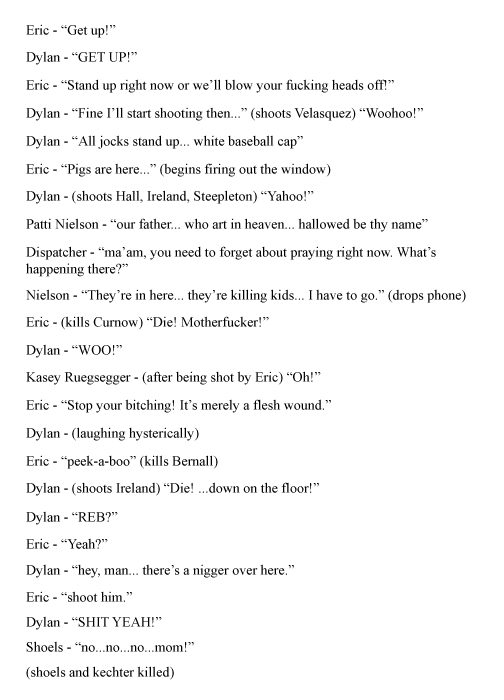
Didn’t Eric say “Fine I’ll start shooting”? That’s from that 911 transcript and different people say it’s fake. Is it real or no?
Different sources say different things. Some have said Eric and some, Dylan, as in this 911 extended transcript while other sources like this Jeffco ‘Finding of Library of Events , simply mentions ‘a witness heard one of the gunmen say’ This seems to be because it isn’t perfectly clear as to who said what. The 911 transcripts vary too. The one I mention above that lists Dylan as saying it doesn’t even have the first interaction they make with hiding students upon entering the library where you can clearly hear the two say on the very indistinct audio clips Eric: “Get up!” Dylan: “Eeeeverybody get up NOW!”
Many of the students in the library didn’t really know specifically which dude said what in the library let alone when they’d first entered into the library. The 911 audio tape that’s on youtube is tbh, a really horrible quality and I wonder how much of a clearer version Jeffco actually has/had in it’s possession. I tend to think not all that better. Also, their 911 transcripts are really incomplete and sketchy.
As I said, many of the students were confused as to which gunmen said what. Only that they appeared in the doorway through a cloud of smoke – probably from Eric’s shotgun and the pipe bombs and crickets tossed just outside the library door. The fire alarm goes off soon after because of the smoke billowing in the air..

The reason I tend to believe that Dylan is the one who’d said it is in relation to the testimony Bree Pasquale gives in conjunction with Evan Todd who was the very first person to be shot but only injured. Todd mentions that Eric is the first to fire into the library (from just outside the door) at Todd who is hiding behind a pillar at the front desk. Eric doesn’t speak just notices Todd; the two make eye contact and Eric racks his round and fires two from his shotgun at Todd who ducks and the damage hits the pillar and slightly injures Todd. According to Bree, Dylan enters into the library slightly ahead of Eric and this is when both begin to yell to everyone to ‘get up now!’ at which point Dylan would then logically say in response to nobody cooperating and doing as they commanded “fine, I’ll start shooting” and would then be walking towards Kyle, who was supposedly very visible not hiding too well if at all, and aiming his shotgun at him. So , Eric shoots first and injures the first person from outside the library and Dylan shoots first within the library and kills the first library victim, Kyle Valesquez. It would make sense that Dylan said ‘fine, I’ll start shooting’ once they’d entered and no one did as they demanded and got up. Unfortunately, there is just no crystal clear way to verify and determine exactly everything each boy said in the library because the evidence released is sketchy.
I disagree. I think he killed less because he had weapons 10x worse than Eric’s, i know a lot about guns. The Tec 9 is one of the worst handguns in history. It jams repeatedly. His Stevens shotgun was even worse. 2 terrible weapons. Thats why he killed less.
While I agree with you that Dylan’s weapons of choice were a bit shitter than Eric’s (I don’t know about ‘10 x worse’ as you suggest), I don’t feel it is the only viable reason for his lagging kill count. It seems a combination of Dylan being more interested in wrecking havoc, terrorizing and raising hell as well as him discovering rather quickly that his selected weapons didn’t perform as efficient or ‘cool’ as he had fantazied about in his head. For example, outside, Dylan’s non factory 50 magazine for his 9 mm Tec supposedly jammed and was dropped on the grass still full of bullets but he still had other clips, two 36s and a 24. I think there was even a magazine found in his BMW that I recall. If he was eager to kill, he still had time to jump right in, reload his Tec 9 to get in some more warm-up target practice but for whatever reason, he didn’t do so. Instead, Dylan chose to mix it up by messing around with the arsenal at his disposal: he chose to wander off near the parking lot and lob pipe bombs. According to record, he tried a mere 2 rounds of his double barrel shotgun – and likely realized it was a horrible distance shot on running human targets. He spent a lot of time going up and down the stairs near the commons and was the most scene by witnesses through the windows. He was the show off presence that shot Lance in the jaw within an audience left to gasp in horror at the windows. It was reported that Dylan even walked in the commons as people were fleeing in a panic up the cafeteria staircase and yet, he refrained from shooting or throwing any of the incendiaries at his disposal. In the hallway, he got in 31 rounds of Tec 9 mm target practice and 4 shotgun rounds but he spent a fair amount of time taking it all with the journey and not the destination: enjoying the site and sounds of destructive impact on Columbine’s interior, running down the hallway chasing screaming students and shooting at the walls and the lockers along the way. He happened to maim a couple of students including aiming, for whatever reason, super low and succeeding a blast on Stephanie Munson’s ankle. Ok, yeah, they’re moving targets and somewhat long distance but an ankle just seems silly. And again, Dylan didn’t wander into the bathroom to hunt down the girl who ran from the payphone. Maybe he hit his limit in murdering etiquette that a gentleman hitman does not hunt down a girl in the girls restroom? lol 😏
Inside the library there was a lot of opportunity for close range kills especially with the shotguns. Dylan succeeded using his shot gun straight off the bat and wounded Kyle Valesquez’s head and shoulder with deadly accuracy, killing him instantly. He started off boldly in the library, as if he were electing to set the tone there by volunteering a “fine, I’ll start shooting!” Thereafter, Eric spent 21 shotgun rounds and the library yet Dylan only a total of 6. Dylan 21 9 mm rounds and Eric 13 with his carbine. I’m not really certain if Dylan’s Tec jammed there, I don’t think so? At any rate, at such close range, you’d think he’d have had better chance at success. Did he perhaps spend a fair amount of time shooting glass display cases or blasting holes in computers and tv sets to supersede Eric’s 9 mm count by 8 ? For some reason, Lauren was the only one Dylan went hog wild on drilling Tech bullets into. Yet, all in total in the library, at close range with sitting ducks under tables or half tables, Eric manages to surpass Dylan at the kill count. Most of Dylan’s kills are in tandem with Eric on a person, even. In the library, Dylan was said to be the more vocal one, whooping it up, hollering and having the time of his life and Eric more quiet and methodical. He spares Valeen after taunting her. He inflicts his verbal wrath on Evan Todd, yet let’s him live and gives him to Eric even, with a ‘you can have him..if you want.’ All in all, to me, it seems that it wasn’t just that Dylan’s weapons sucked but that he was simply less motivated to murder with deadly intent and accuracy and more interested in terrorizing and enjoying the power trip. Here’s a total shots diagram for anyone interested.
Iv just always wondered about the ‘I did try to call you but you must have been asleep’ or the ‘maybe I should call her or wait for fate’ lines in his journal , do you think he knew ‘her’ in the sense that he had her phone number as a friend or could it be a computer hacking school scenario to get her number,I just can’t imagine him having the nerve to call his love,unless he had a bit of liquor courage that is???
Yeah, he knew this particular her that he was trying to work up the nerve to call. I think liquor courage helped him manage to take a deep breath and dial that number of hers. (He was known to have used liquor courage while chatting up girls online like, for example, Sarah Slater). Dyl spent so much time enumerating about it that he missed her because it was too late and he then concluded, with a sigh of relief and frustration, that she must be asleep. He knew her number because he knew her just well enough to obtain it.
Isn’t it strange how even though Dylan would threat the kids during the shooting more, he didn’t kill as much. Whereas Eric was calmer, but killed more. It’s so strange
No, not really strange. It’s just that Dylan was more into the thrill of psychological terrorizing classmates rather than Eric who was trigger happy for the kill counts – well, that is, until he broke his nose and was less methodical about killing as many as possible. Once inside the school, Dylan got off running down the hall chasing after people, shooting haphazardly at students and lockers and walls, yelling like it was his last, big party. At the end of the hallway, a girl was on a pay phone talking to her mom and saw Dylan approaching peripherally. She dropped the phone and ran into the girls bathroom. Did Dylan pursue her? Nope.
Dylan liked the power trip of being threatening but not necessarily a deadly, precise threat. In the library, he walked around insulting students and suggesting threatening things out loud to Eric, hinting to his audience cowering under the tables that maybe they should use their knives because he always wondered what it would feel like to cut someone. It was an idle threat he suggested loudly while his boots were on either side of a girls leg sticking out from underneath a table as he reloaded his weapons above her. Yes, of course Dylan killed too, but he enjoyed the terrorizing more and so by comparison, he killed less than Eric.


The killers’ bodies are taken from the school. There’s nothing left now but aftermath. The snow begins to fall as they’re hauled away. Big, locust flakes, blown by an east wind, banishing the earth, unbelievable except for the fact that they’re real and cling to everyone—the camera crews jockeying for tears, the governor’s entourage, which has just arrived to inspect the decimated building, and the kids, wearing tranquilized masks, who gather to mourn at makeshift memorials, held up by one another, their hair covered in veils of white.
On the night of the massacre, the minister, Don Marxhausen, calls an impromptu service at his church. “The body of Christ,” he murmurs again and again, and near the end of Communion a female parishioner approaches, answering not with “Amen” but “Klebold.”
“The body of Christ,” he says again, confused, but again the answer: “Klebold.”
“Don’t forget them in their hour of need,” she says.
Shortly after, Reverend Don gets a phone call from Tom Klebold, the father of Dylan. “I need your help,” he says, “but it has to be confidential.”
Reverend Don doesn’t shy from complicated spiritual transactions. He goes where he’s most needed, reaches out to those who most need lifting. He carries his 240 pounds as if he could still do a little damage in hell if he had to. Among the conservative evangelicals who dominate this place, he’s a liberal misfit. If you can’t laugh, even in the worst times, he says, if you can’t find some smiling note in the dirge—or, at least, forgiveness—then you may as well forget about salvation. So he agrees to do the memorial service for Dylan Klebold because the boy is a misfit, too, and still one of God’s children.
When he arrives for the service, Sue Klebold, the mother, embraces him. He can feel her trembling, and she leads him to an open casket in which her son Dylan—the killer formerly known as V—has been laid to rest. The image of him sleeping here, coiffed for good-bye, is startling: He’s surrounded by Beanie Babies, a ring of them that runs from one ear to the other.
How does one commend this sweet boy, a mass murderer, to heaven? Reverend Don doesn’t even try. “Do you mind if we just talk for a while,” he says, “and then we’ll worship.” And so they do. One couple says that the Klebolds are great parents. And another couple agrees and chimes in, “He was like our son!”
Then Tom Klebold speaks: We don’t believe in guns. We’ve never had any in our house.
And Sue: I don’t understand the anti-Semitism. I’m his mother, and I’m Jewish.
It goes like this for forty-five minutes—this confusion and disbelief suffusing everything, though they really try to remember him for the funny, sensitive kid he was. Only Dylan’s older brother remains silent. Nothing negative is said, though the enormity of what has brought them here crushes down on everything. How do you reach these parents who have not only lost a son but whose son set out, it seems, to kill an entire town?
Reverend Don tells a story about how, in the Bible, David, the king of Israel, once had a son named Absalom, a beautiful boy who was a fierce rabble-rouser, inciting civil war against his father. In the end, David’s loyal general, Joab, was forced to kill Absalom in order to restore the kingdom, and yet David, when confronted by his son’s body, was so overcome by grief, he broke down. “Would God I had died for thee,” he wailed, “O Absalom, my son, my son!”
It is the perfect parable about the purity and endlessness of a father’s love, no matter what the situation. And the Klebolds cling to it. After a few blessings, they’re done. Dylan is later cremated—for fear that a grave site would be defiled—and when the minister asks one of the Klebolds’ legal representatives what to do in case the media come calling, Reverend Don is mildly surprised when the man says, “Just tell them what you’ve seen here tonight.”
And so he does. He agrees to two nationally televised interviews. To America, he describes the Klebolds as a family in deep, unimaginable pain. About the service, he says he saw two innocent parents “questioning where their son came from.” He stays in touch with Tom and Sue, visits occasionally. Tom, a former geophysicist, rarely leaves his house. The driveway has two gates on it, and he sits up in his office, cloistered from the world. Sue has a position with a local college, working with the disabled. She pens letters to the victims’ families, expressing her grief. She has so many questions now about her son. She invites a small group over to watch the prom-night video they took of Dylan. He wore a tux and went with a friend, Robyn, a girl who also secretly bought guns for Reb and V. But in the video, they’re merely high school seniors, pinning each other with corsages, giggling embarrassedly, then getting into the limo on one of the biggest nights of their young lives. Sue Klebold scours the television screen for clues. There are no clues.
As for Reverend Don, when he twice defends the killer’s family on national television, when word leaks out that he led Dylan’s memorial service, well, something turns and hooks in his parish, and they begin to hate. There are forty-six families here who had kids inside Columbine High School that day, and suddenly he’s Absalom.
On the first-year anniversary of the massacre, even as the reverend addresses thousands in Clement Park, his church council unanimously votes for his firing. Within three months, he sells his house, packs and is banished from Littleton, Colorado, for good.
[Source for this entire beautifully written 2004 article –Columbine Never Sleeps]
People will ask me what I remember most about grade school with Dylan Klebold. Sadly, my strongest memory is both of us kneeling on the floor of the Normandy Elementary School bathroom, bawling our eyes out as we took turns scrubbing a little girl’s muddy jacket with a tooth brush.
Brooks Brown, No Easy Answers (via rebdomineandvodka)


Brooks just mistrusts himself. How could he have had a friendship with Dylan and not seen what was coming? How could he have prevented it?
At odd times, he remembers Dylan—the kid, not the killer. He remembers being in an economics class with him when the teacher put a bunch of fake money on the counter and told the students to split into teams and take $5,000 each, mock-invest it and see what kind of profit they could turn. The idea was that they would be rewarded with more fake money, depending on their gains. And while everyone sat there, obsessing over their gains and losses, Brooks and Dylan stole to the front of the room, scooped up a pile of money, and won the game. Not exactly the stuff that gets you into Harvard—though both of them had the IQ for it—but just funny shit.
When Brooks remembers this, he can’t stop laughing. He seems absolutely lost in that long-ago moment, almost talking to himself. Right now he’s 23 and has no college education, no regular job. He plays video games until the early hours, then sleeps late. The Insane Clown Posse sings out: Watch your step to hell…. It’s a long fall! And Brooks Brown is remembering.
“Dylan and I, man…with all the money…. It was…just so…so fucking funny.”
That he laughs, that he chooses to remember, that he was friends with a boy who morphed into a monster and doesn’t pretend otherwise — does this make him guilty or innocent?
[Source for this entire beautifully written 2004 article –Columbine Never Sleeps]
And what of this boy here, Brooks Brown, a senior so preternaturally smart and distractible he’s bored at school? He’s friends with different people, in different cliques—athletes, brains, computer nerds—and yet regards himself, with somewhat melancholy pride, as a geek loser. In the halls of Columbine, he feels isolated and alone. The difference between him and Reb and V, both of whom he knows well, is that he doesn’t feel violence toward his school or himself. But he will. Soon after his life is ruined by Reb and V, he will.
After that, they will hunt their avowed enemies, the ones whose names are compiled on a hit list headed by Brooks Brown. Finally, Reb and V have rigged their cars to explode, killing anyone lucky enough to make it out alive.
In the parking lot at Columbine, the boys keep waiting for the cafeteria explosion that never comes. And as they wait, Brooks Brown appears, cutting choir, heading out for a smoke. The timing of this meeting is full of cosmic irony and will be questioned long after the fact. Only last year, Eric Harris posted death threats against Brooks on the Internet, threats that the Browns then took to the police, who filed a report and forgot about it.
Brooks just assumed that Eric Harris was threatened by his friendship with Dylan Klebold, whom Brooks had known since they were in the same Cub Scout troop at the age of 7. So Brooks tried to make peace with Eric recently, as a matter of high school survival. And somewhere in his planning for this judgment, Reb checked his list, and, checking it twice, crossed out Brooks’s name. In the margin, he scrawled the words, Let live.
Now, Reb turns to Brooks. “I like you,” he says. “Get out of here.”
By the second week, the police arrive to question Brooks Brown, and a few days later the sheriff, John Stone, announces on national television that Brooks is a suspect, a potential collaborator despite having been the first name on Reb and V’s hit list. There are others whom Eric and Dylan knew—like Robyn Anderson or Phil Duran at Blackjack Pizza or Phil’s friend Mark Manes, who unwittingly aided Reb and V by either selling or brokering guns for them—but it’s Brooks who becomes public enemy number one.
He’s not permitted to attend the remainder of his classes at Chatfield High, where all of the Columbine students have been moved to finish the year on a staggered schedule. A member of the chorus, Brooks sings at a memorial and is threatened by someone in the choir standing behind him on the risers. People hiss and murmur and sometimes scream when they see him: Murderer! This hate becomes dangerous, and the Browns try to stanch it. They give interviews, fight back against the school and the police, whom they’re sure are trying to sacrifice their son. The sheriff’s office denies that the Browns ever contacted them about the Internet death threats from Eric Harris, and yet, in the immediate aftermath of the shootings, they used that very same police report as evidence when asking a judge for a search warrant for the Harrises’ house. Six months later, when Brooks moves out of his house to live with his girlfriend, the family converts his old bedroom into a Columbine war room: Black binders of evidence fill bookshelves; diagrams of the school hang on the wall, marked with color-coded dots for each of the 350 bullets fired that day, as many as a hundred of which can’t be explained.
When Judy sits at the kitchen table, wringing her hands over it all—and she does this nightly—she wonders where this is leading, reliving Zero Day from every angle, reviewing crime-scene photographs, listening to an enhanced 911 tape that broadcasts the killers’ voices and the thud of shots fired into human bodies. People in Littleton no longer want to talk about the shootings—and they marginalize those who still do. They want Zero Day to disappear, to become a story that becomes a rumor that time forgets.
So what is this about? Even as the Browns come to be seen by the community as pariahs, this is about saving Brooks. Brooks, who’s grown his hair out and dyed it purple. Brooks, who listens obsessively to the Insane Clown Posse and considers himself one of the band’s followers, known as Juggalos, whom he defines as “hurt and angry hippy-geeks.” Brooks, who molders in the unfinished basement of his house in a Denver-area subdivision, behind three plywood tables set with computers, with two of his buddies, one of whom delivers Domino’s Pizza, and plays video games until dawn on the big-screen. “Yeah, some of the games may seem violent,” says Brooks, “but it’s pretty tongue-in-cheek violence.”
So come in. He’s down here right now, stuck on Zero Day because what Zero Day did to Brooks was erase an essential part of the hard drive that stores human faith and trust. Even today, years later, a balloon pops and many Columbine kids still hit the deck. A siren sounds and they burst into tears. Others, rather than living with more tolerance, mistrust all misfits, freaks and loners. {Excerpt Above] Brooks just mistrusts himself. How could he have had a friendship with Dylan and not seen what was coming? How could he have prevented it?
Can you feel where this is taking us? Time keeps moving backward. The teenagers are becoming children again, as they’ve always been. A boy named Brooks poses in a picture with his friend Dylan, dressed in Cub Scout uniforms.

Now they’re running backward out the doors of the elementary school, their feet in funny kicks, to their mothers in waiting station wagons. The children pull apples from their mouths, place them whole on the table and shed their clothes for warm pajamas. Even as their mothers wake them, they fall back to sleep. Long, unbroken hours of sleep during which their hands grow smaller.
Only someone like God could tell us what they dream now, sleeping as they do. But sometime during this night, God temporarily goes missing. A primal force moves the stars. Snowflakes fall like locusts, banishing the earth. Somewhere, in this night, an errant seed lights down. A silver hook fastens. These are not supernatural acts. This is real.
Now let the terrible glare of time begin forward again. It’s dizzying, this speed. Can you feel it? The babies become teenagers. The guns are bought and hidden in the closet, waiting. The road is cold and silver, swerving all these years later to Columbine High School, where, in blinding sun on a seventy-in-April day, with laughter floating from the cafeteria, two boys cross the parking lot.
Two boys are crossing the parking lot now—crossing again…and again. And for the last time: These killers are crossing the parking lot again. No one stops them. No one even sees them. What comes next is irreversible: We are eating lunch on the lawn, going for a smoke, finishing our homework.
Listen: There’s innocent laughter—and then, in a second, there’s none at all.
Infinice isn’t a word either
No, it isn’t; you’re correct there. You won’t find it in the Webster dictionary nor sadly even Urban Dictionary.
However, infinince is a word created and breathed life into by Dylan Klebold.
It’s his word and so when I borrow it, it’s in his context. 🙂
Dylan in his journal doesn’t seem to use the word “halcyon” correctly. Any idea why? Did he know it and was just doing it his way?
Dylan likely became aware of the word through any number of high school required reading (and classical) literature that reference the word in addition to that, the word was around during the later half of the nineties since the techno group Orbital released it’s live single ‘Halcyon, On and On’ from off their In Sides ‘97 album. It’s a given he knew what the word truly meant but he chose to put his own spin on it and use it in a context of a tranquil, blissful place of existence or a spiritually perfect state of being. The warmest seas of pure happiness. essentially, his own brand of Heaven. 🙂
What did dylans flannel that he wore in the goodbye video look like

Dylan’s actual plaid flannel shirt found discarded between the front seats of his BMW.
I thought that was the footage Nate Dykeman sold to the tabloids of him and Dylan for 17,000. Why would Jeffco be the ones editing anything out? Or am I confusing two different things.
Correct. If you watch the documentary “Columbine: Understanding Why” which is available as a dvd on Netflix (it used to be available on instant video but not at the moment and it was deleted off youtube due to A & E’s copyright infringement), they show a segment of the Morning Ritual and you can see/hear a few seconds of Nate and Dylan making idle small talk while driving towards Dylan’s assigned parking space in the senior lot. However, In the video edited for public consumption on the internet, the Pulp Fiction soundtrack is cranked up during that segment and any dialog between Nate and Dylan is non existent. Nate and Dylan filmed this for Nate’s dad back in Florida so he could see what it was like for them getting up and going to high school every morning.
You needn’t watch the video carefully to realize that it is hacked to pieces and spliced together sloppily. It clearly isn’t the original footage of Nate’s with all the conversations between them while doing a ‘day in a life’ driving to school. I was going to post this segment where you can hear the two talking a wee bit in the parking lot but by that time, youtube had removed all instances of it. I’m sure it’s probably available somewhere like a Torrent if you don’t have Netflix.
Oh sorry to ask another question but what could they have been editing out of the morning ritual video? it’s obvious they edited out parts of them speaking. what could they have possibly said jeffco didn’t want us to hear. jeffco just pisses me off
Probably just them discussing daily goings on at the school and referencing names of people – friends, teachers they like or hate and foes that irritated them. Also, I think Jeffco preferred we not be vicariously listening in on two friends talking about mundane things because it might make Dylan seem less of a monster and rather more accessible and appealing as timidly ordinary and goofy in idol conversation. As it is, Dylan already captivates and does a number on us with his disarming close-camera eye contact and inimitable hand wave. Hearing them talk and maybe laughing at what they might be saying as two boys hanging out? Nuh uh. Jeffco would rather bar us from eavesdropping in on their potentially relatable teenage discussions while driving to school. Killers must remain unknowable so as not to garner sympathy or understanding.
when was the morning ritual with nate filmed? please and thank you
I’m going to say anywhere between the winter months of Nov ‘98 – Jan ‘99 leaning more towards ‘98.
Two clues here are:
Nate Dykeman says “On a cool frosty morning.” and ”We’re talking something about parole here early May.” There is some half melted snow on the ground. I don’t know Colorado winters that well but I would bet there is a lot more snowy days in Dec-Feb months.

The most important thing here is that Dylan’s hair is still relatively short.

In the week of December 7 – 11th when Hitmen for Hire was filmed, Dylan’s hair looks just a inch/inch and a half longer than it does in the Morning Ritual video.

By March ‘99 in the Rampart Range footage and Radioactive Clothing, Dylan’s hair is quite long and ratty looking sticking out like clown hair under his hat.

Given Dylan’s short hair length and the amount of snow on Columbine High grounds, I would tend to say the Morning Ritual video was filmed middle to the end of November ‘98 but honestly could also have been into December since he hair length is pretty close. Another thing.. the leaves are pretty much off the trees so mm.. December seems even more likely!


Good Friends and
Best FriendsKindred SpiritsI just thought it interesting to note that Dylan remembers Zach Heckler’s birthday in his day planner, enough to mention it – but seemingly not Eric’s.
Dylan writes about Zach Heckler in his journal 7/23/97:
“My best friend ever: the friend who shared, experimented, laughed, took chances with & appreciated me more than any friend ever did has been ordained … “passed on” … in my book. Ever since (Devon) (who I wouldn’t mind killing) has loved him … that’s the only place he’s been with her …if any- one had any idea how sad I am … I mean we were the TEAM. When him & I were friends, well I finally found someone who was like me: who appreciated me & shared very common interests.”.
Dylan writes about Eric Harris in his Diversion Questionnaire Jan ‘98:
“Friends for about 4 years, (scribbled out ? was he considering the word ‘best’ and decided against it?) very good friends.”
Classic reblog since this one keeps getting the reblogs today. 🙂
Did Dylan want his journal to be found?
why did dylan not get rid of his journal? ie the parts where he speaks about personal things like the girl he loves
Ultimately, yes. Dylan had three computers and he deleted his main go-to hard drive. But his personal journal? Did he rip it up into tiny pieces and bury it deep into the trash or burn it into nothingness, even? Nope. He could have disposed of it quite easily too. I get the sense he considered what he’d do with his journal and waffled back and forth in his mind about it just as he’d purposefully and rather decisively chose to delete and eradicate the contents on a specific computer of his. Within the very last days or maybe even the early morning hours of 4/20, he just simply decided to let. it. go. and leave his journal behind and intact somewhere in his bedroom to be retrieved. I don’t think he considered the cops taking it or it eventually allowing it to be scanned and publicly posted and broadcast for the world to see. His general intent was to leave a piece of himself behind by way of his journal for his family, mostly for his parents, so they wouldn’t be left completely and utterly in the dark about why he decided to end the life that they’d given him as his creators. It would be out of respect to them, for the good parents they’d been to him and not such a brutally incomprehensible mystery. It would be his standalone personal story apart from his rants along side Eric in the Basement Tapes. It would allow his parents to glimpse into the silent suffering he shouldered alone and didn’t seem to detect along with everyone else who had been blissfully ignorant of his pain. His final decision to leave it behind would’ve been a quick one. He wouldn’t have made the choice dwelling on some of the excruciatingly private specific passage of his journal that he would be allowing his family access which would have been mortifying to him in his human form. Dylan would’ve had to have come to the conclusion that it wouldn’t have mattered anymore anyway who ended up discovering his journal since he would no longer be around to consciously know that they now knew everything that he longed for or endlessly tormented over so badly in this existence.The discovered journal would be him in it’s rawest and purest most honest form that no one had privy to while he was alive and breathing in suffering silence. His choice to leave it behind was his dedication by default “to mom and dad”. It was a bit of a devil-may-care gamble, a wildcard decision, to leave it behind in regards to where it might end up. Dylan’s subconscious ‘message in a bottle’ even – a kind of “to humanity (in case you care, maybe – (not?) – here is how I suffered and ended up becoming what you made of me .”
Wait so Dylan was actually unemployed from December ’97 – December ’98, a whole year?! I had no idea. I thought he quit BJ Pizza, and came back a few months later. Where the hell was he getting his cash for bombs if he was only working maybe 3-4 months before 4/20 + only working 10-15 hours a week? That’s insane.

Dylan turned sixteen Sept 11, 1997, the legal working age in Colorado. Eric helps Dylan land the job at Blackjack in either Oct/Nov ‘97 which runs to about Dec ‘97/Jan ‘98-ish. This is taking into account that Dylan said his longest period at one job was three months. Dylan brings a pipe bomb into Blackjack and shows it off with instructions on how to make one. He then gets reprimanded for it. A couple days later, Dylan quits. The pay sucked anyway and ultimately he really wanted a more ‘dream job’ working in computers.
In between this time, he lands a short stint as a courtesy clerk at Albertsons. He quits saying ‘Didn’t want to join the union’ which is a P.C. way of saying he fucking hated doing customer service, lol – and Connie annoyed him.
See here for other jobs Dylan worked in ‘98.
In December of ‘98, Blackjack owner, Bob Kirgis, is in a jam for employees and rehires Dylan back on. This was approximately ten months after, give or take, his first employment there, his second and last time working at Blackjack pizza, Dylan works more hours and is there from Dec ‘98 until April 16, 1999. His wages on his last pay check are $6.50 per hour.
No, Dylan wasn’t make a whole lot of money, folks. Before he was seriously saving for NBK, he was just scrapping by. Above you can see the percentages he’s devoting a measly 10-20 hour paycheck to: Gas money – $40, Insurance (he got his BMW not too long ago and puts a “?” by cost. Maybe the parents were still paying it for him at this point, so he didn’t know how much that was eventually going to cost him.) He mentions ‘Savings” was 50% of the paycheck. Whatever was left over (not a whole hell of a lot) was likely entertainment spending money. Rock n Bowl on the weekend or buying some cds, video games, or renting or going to the movies. I don’t believe serious NBK expenses were set aside at this point. The boys only got serious about NBK right about here actually, with the start of this intake file dated 3/98: after the van theft incident and during the beginning of the Diversion Program which lasted all of ‘98.
Dylan saved when and where he could for NBK which means that Eric probably pretty much contributed to most of the saving during this year. Dylan did odd jobs for his neighbor in June ‘98 and Computer Renaissance in August ‘98. He probably also got some money working the fireworks stand each summer and perhaps, a regular allowance from his parents. By the time Dylan worked Blackjack his second and final time from Dec ‘98 – April ‘99, he really would’ve been putting in a much more concerted, serious effort to stockpile his paycheck for NBK.
It’s no wonder that Dyl moped when his pricey signature shades broke on him? Saving another wad of cash to replace the pair wasn’t in the cards of Fate any longer. Saving for a future of death was far more important than his aesthetic.
did dylan have a job in between the 2 times he worked at blackjack?
Yes. Dylan worked at Albertsons grocery store for about a month, approximately Jan/Feb ‘98.
While sending out his resume and looking for work all spring of ‘98 (even stooping to apply for McDonalds) in June of that year (during summer break after he’d finished his Junior year), he settled on doing some maintenance, landscaping/yard work for a next door neighbor to make some extra cash. (Bryon used to work for these neighbors and helped take care of their horses)
In August ‘98, Dylan worked at Computer Renaissance as a computer technician. This job which was supposed to be his dream job at the time, didn’t last too terribly long.
In December ‘98, Dylan gets rehired by Bob Kirgis of Blackjack Pizza because they are in a pickle for help. He gets a raise and begins working more hours than his first stint with Blackjack. The majority of the NBK finances would’ve been stockpiled during this time.
 The Everlasting Contrast