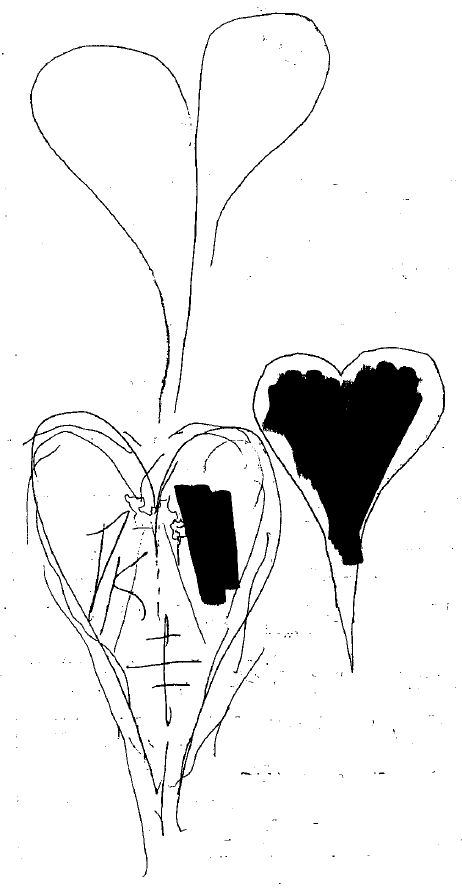
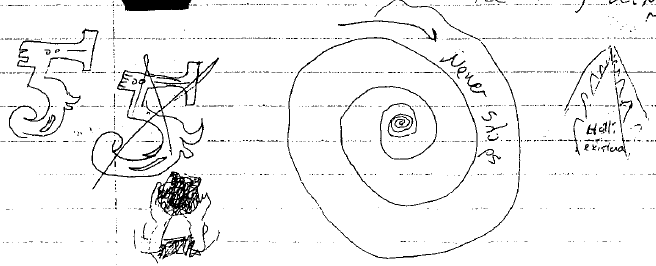
The boys’ goodbye or explanatory message was the very last Basement Tape which they videotaped 30 min prior to the massacre. Eric also recorded the Nixon Tape which he left on the kitchen table or counter at his home – it’s content likely was a bit of an explanatory message. Neither wrote suicide or goodbye/explanation notes.
do you think dylan ever did words or names when self harming, maybe the name of his love or something?
I was Mr. Cutter tonight — I have 11 depressioners on my right hand now, & my favorite
contrasting symbol, because it is so true & means so much.4 The battle between good & bad
never ends …
As per the journal entry above, Dylan cut depressions (’depressioners’) or slash marks (various degrees deep) on his right hand as well as his “favorite” everlasting-contrast symbol. It seems likely to me that Dylan would’ve carved his distinctive broken-yet-united heart halves and inserted the initials of his name with her own on the other half of the heart..but in a more unobtrusive part of his body well hidden by his clothes. Also, his symbol for Fate and the Downward Spiral and his mysterious 5 would hold enough resonating significance for him to carve on his being.


The Winning Potential of a Brilliant Mind
Rotisserie (or fantasy) baseball is a game in which individuals “draft” real ballplayers into imaginary teams, keep track of statistics on the players’ performance, and win or lose depending on how well these statistics add up at season’s end. (It usually contains a gambling component.)
From the few references to fantasy baseball in the Littleton coverage, we know the following: Dylan Klebold, a Red Sox fan, played in Columbine High’s Rotisserie baseball league. He took part recently in a Rotisserie baseball draft party.
Apparently he was quite a skillful player. On the day he shot up his high school, Klebold’s team, the Border Hoppers, was leading its division.
“He was awesome,” classmate Chris Hooker told USA Today. “He was so awesome we thought he ought to manage a team in real life.”
[Conspiracy of Silence – Slate]
Not even Bud Selig, who has presided over some bizarre situations on his watch, can match the crisis facing Chad Laughlin, commissioner of his fantasy baseball league.
The Columbine Fantasy Baseball League.
You know what happened in Columbine. You might not know that Dylan Klebold, one of the accused shooters in the high school massacre, was the owner of the Border Hoppers team in the Columbine Fantasy Baseball League, which consists of teams owned by Klebold’s fellow students.
Klebold and Laughlin had been friends since third grade. They used to play baseball at the park and trade baseball cards. When Klebold heard three years ago that Laughlin was running a fantasy league, Klebold joined up.
Nobody can ask Klebold what fantasy baseball meant to him, but Laughlin has an idea.
“The owner of the Salty Squirts team (Tim Kastle) was inside (the school) and Dylan could have shot him, but he didn’t pull the trigger,” Laughlin said during an on-line interview. “He let who he liked go.
“Maybe it’s too much of a stretch to conclude that Kastle is alive today because he played fantasy baseball with Klebold, but that’s what Laughlin thinks.
Laughlin also decided the Columbine Fantasy Baseball League would carry on after the tragedy.
“We are continuing it on the basis that it keeps the owners’ minds off of all of this,” he said. “It is a good way to get away and forget about everything else. All the owners agreed on that.
“Klebold, said Laughlin, knew his baseball.
"He was first in his division, most points in the league,” Laughlin said. “I never really hung out with Dylan outside of school during high school, but every day during video class I’d talk with him about baseball for 30 minutes or so. He was an active owner.
"If it’s hard to picture this fantasy team owner as a mass murderer, well, it’s even harder for Laughlin to comprehend.
"I never felt threatened by him, I was never afraid,” he said. “I just looked at him as a friend. Not a great friend, but more than an acquaintance. No one knew anything about this tragedy coming – no signs, no warnings, no one to point fingers at. I know that Dylan’s parents didn’t know or they would have done something. I used to spend the night at his house a lot, so I know them fairly well.
"Like everyone else in Littleton, Laughlin is tired of the investigators and media vans and the steady stream of people who pass the school memorial.
"It’s sadly almost a tourist attraction,” he said. “Maybe by the end of the month, things will be almost normal again.
"Whatever normal is, to a community that has gone through the unthinkable. For Laughlin, normal includes fantasy baseball.
"I really want to keep the league going, not because it’s famous or anything, but it’s become a tradition. For years to come. Owners will go off to college, but by it being online they can still be in it. And I want to make the site better, but it takes a lot of time. I haven’t had much of that lately. In fact, right now I’ve got to get to school.”
[
Columbine Fantasy League Will Carry On
By Ken Gurnick
5/12/99
]


Calvin and Eric, Dylan and Hobbes – Part 1 (of 3)
by Douglas Ord, Lear’s Shadow
The three parts of “Calvin and Eric, Dylan and Hobbes” date from the summer of 1999, just after Columbine, and were part of the first
Lear’s Shadow
upload to the internet in May, 2000. This means they also date from
before the release
of Eric Harris’s and Dylan Klebold’s journals, along with many other documents, on July 6, 2006.
This 2006 release, along with multiple other factors, made for extensive re-assessment, and when these texts were taken offline in 2008 it was partly to facilitate the return to print syntax required for sustained rethinking. This further development is available in
The strangeness of Columbine, an interpretation
, which was published via ebook in January 2012, and which contains no duplication of this or other earlier material.
“Calvin and Eric, Dylan and Hobbes” is being restored as first published in part because it provides an early record of stunned recognition of … something. There are flaws: among them too tight focus on Eric Harris to the exclusion of much else. But it is also restored because foolishness has circulated that it articulates a belief that
Calvin and Hobbes caused Columbine. This at least sets the record straight.
As for the collage: it dates to December, 2000.
It was produced, amid the density of early internet exchange about Columbine, so other people could see, in immediate terms, the similarities that had propelled the texts already on Lear’s Shadow.
These were uncanny.
Eric Harris as a human Calvin (as the name had been re-applied, with utmost genius, by Bill Watterson). And Dylan Klebold as a human Hobbes (as this name, too, had been re-applied, ditto, by Watterson).This human Calvin and this human Hobbes, however, were at the ages of just-eighteen and seventeen, mass murderers.
All four of the above images were in circulation, in media ether, in 1999.Columbine, a terrible magnet, drew them together, into collage.
From 1985 to 1995, the comic strip Calvin and Hobbes ran in newspapers throughout North America. As conceived by Bill Watterson, the six-year old Calvin was perhaps the most nakedly sensitive, exotically intelligent, and pathologically imaginative character ever developed in a comic strip. But Watterson stopped producing Calvin and Hobbes in December 1995. Why? Did he begin to realize that, were he to keep Calvin at six years old, the strip would soon slide into the tired repetition that befell Peanuts after the brilliance of the 1950s and 60s? But did he realize also that, unlike Gary Trudeau with his Doonesbury characters, there was no way he could keep the strip funny if he let Calvin age with the times? For Calvin, growing older, would not only have had to face adolescence. He would also have had, so as to have human friends at all, to get rid of Hobbes, whom others saw simply as a stuffed tiger. And this might have been very difficult, for Calvin as a character, as for the strip itself.
Why so difficult?
Because Hobbes, as brought to life within the strip by Calvin’s waking dream, was obviously so much more than what “others” saw. As a truly noble beast, he became, at different times, the voice of sophistication, of charm, and of irony. A voice, that is, which was almost entirely denied, in Calvin’s real world American suburban vicinity. Part of Watterson’s genius was to create that voice without a history, and without a past: the voice, in this regard, of a truly American tiger. Yet this was also a voice that, in its understated wit, its eloquence, and its sensitivity to shades of meaning, paradoxically suggested Europe. Not contemporary Europe, but the Europe of Proust and Camus, Joyce and Beckett, Heidegger and Wittgenstein. The Europe that, speaking through Hobbes, could remind Calvin gently that he had misspelled the word “Weltanschauung.”
But Hobbes, while being an awesomely indulgent and intelligent playmate, was also complex in a different way. As a presence, he both personified and contained the projection outward of a coiled spring rage that – as kept within the waking dream – could then rebound on Calvin harmlessly, as he and Hobbes bantered with one another, mocked one another, sometimes even thrashed one another, in the privacy of Calvin’s backyard. How big was that rage, though, that potential for violence? In this there was a critical uncertainty, and even a mystery, because Hobbes himself had a night-time side that, apparently on Watterson’s whim, could stalk and terrorize Calvin: the side that was captured in Calvin’s own description: “homicidal psycho jungle cat”.
So what would have become of Calvin had he grown older, and was gradually weaned by “society” from his dependence on Hobbes? Calvin who, as he lay bruised after yet another beating at school by the brutish Moe, whispered: “It’s hard to be religious when certain people are never incinerated by bolts of lightning.” But Calvin who also fantasized himself, vengefully, as the C-Bomb, “about to unleash the pure destructive force of a million A-bombs!” Calvin asked for “a long-range thermonuclear ‘smart’ missile launcher” from Santa Claus for Christmas. Sought at the age of six to purchase bomb-making materials from the local hardware store. Dreamt of using an F-15 fighter- bomber to turn his public school into “a smoldering crater.” Even wrote a report extolling “natural selection”, in which Susie Derkins gets devoured by a pack of dinosaurs, and in which his classmates “huddle in stupefied horror,” wondering “which one of them will be next.” Calvin also, in one especially… prescient sequence, grouped fourteen tiny snowmen at the bottom of a hill, climbed to the top, got on his toboggan, and said: “For the townsfolk below, the day began like any other day.”
“The day began like any other day…”
The day did begin like any other day. Didn’t it. Or to rephrase the question “What would have happened to Calvin?” in a slightly different way:
How many people were killed at Columbine High School, besides Eric Harris?
Fourteen.
What did Eric fantasize himself as, in one of the stories that he wrote for school?
A shotgun shell.
And what was Eric wearing, underneath the trenchcoat that he quickly removed, once he and Dylan Klebold started shooting?
A white T-shirt. Across whose front were inscribed the words: “NATURAL SELECTION”.
Perhaps Calvin did grow up. In some sense.
The slight build. The expressive features. The spiky hair. Even the slightly crooked smile, that gets – or got – longer and thinner toward one side.
“I don’t want to catch the bus,” Calvin says. “I don’t want to go to school. I don’t want to be here at all. I’m sick of everyone telling me what to do all the time! I hate my life! I hate everything! I wish I was dead!” A pause. "Well, no, I don’t,“ he continues after a moment’s thought, "Not really.” He scowls again. "I wish everyone else was dead.“
How did this sort of wish mutate for Eric? At nearly twelve years older, he had done some reading. "If you recall your history,” he wrote in his journal, “the Nazis came up with a ‘final solution’ to the Jewish problem. Well, in case you haven’t figured it out yet, I say ‘Kill mankind. No one should survive.’”
Or consider Calvin’s fantasy, drawn by Watterson in appropriately Fraktur script, as he plays with his tinker-toys:
…then there was Calvin!
Calvin, the mighty god, creates the universe with pure will.
From utter nothingness comes swirling form!
Life begins where once was void!
But Calvin is no kind and loving god.
He’s one of the old gods.
He demands sacrifice!
Yes, Calvin is a god of the underworld!
And the puny inhabitants of earth displease him!
The great Calvin ignores their pleas for mercy and the doomed writhe in agony!“
Not a word-for-word duplication. But pretty close.
In ten years of comic strips, Calvin, of course –and Bill Watterson via Calvin– revealed immense complexity. And even though Eric Harris, as a person, got to be twelve years older than Calvin did, as a character, there is not the availability of a daily text –or for that matter very many of his writings– to reveal the complexity in quite the same way. But there are some texts, as well as comments by others.
The description of Eric by his friend Brooks Brown, for example, as "an incredible individualist. Charismatic, an eloquent speaker, well read.”
Was it not Eric who took an incandescent delight in putting words together, as in the long “Jo Mamma” chant on his website: “Jo mamma so stupid she think dat PTA stands for Paranormal Transindustriational Activators… when it doesn’t. JJJEEEEYAAA!!” And was it not Eric also who came up with the Latin compound “Rebdomine” for his website? And who quoted Shakespeare’s Tempest, to say that “Good wombs have borne bad sons.”
And who also said, on the videotapes that were made before the shootings: “I wish I was a fucking sociopath, so I didn’t have any remorse… To everyone I love, I’m really sorry about all this… But war is war. And this is war.”
Back in May 1999, TIME Magazine referred to Eric as a “Bad Seed”. As the quasi-official voice of middle-brow America, it has also called him “cold and manipulative”, and –with Dylan Klebold – “evil”, a “monster”, and a “natural born killer.” How comforting this must be, in the effort simply to label him dismissibly Other. A “bad seed”? The simple- mindedness of the label is comforting, for those who do not want to think too much about Columbine.
But for those who are willing to think: these resonances are only a few among many, in that strip after strip of Calvin and Hobbes can now be read differently after Columbine, and can seem to suggest a strange anticipation. They are so striking, these resonances, as to suggest also that, in some uncanny sense, Eric Harris –small of build and brilliantly articulate, but full of rage – was the Calvin that Watterson did not let age, perhaps was afraid to let age, and so simply tried to make –as both a character, and as part of his own imagination– go away.
Except that, in “creating” Calvin, Watterson’s genius had perhaps escaped this status of being “owned” by an author, to become a conduit for something stronger, bigger, scarier. For a cultural energy which was not going to go away.
Any more than would the energy that found shape in Hobbes. For would Calvin, growing older, and having been obliged for the sake of propriety to put Hobbes away, not likely have met, perhaps, another boy who reminded him… of Hobbes?
When would he have met this boy? And what might have happened when he did? Consider this exchange:
Hobbes: “Interesting title.”
Calvin: “Thanks.”
Hobbes: “Specifically what exploits are you referring to?”
Calvin: “That’s the problem. Can you help me think of some I could do?”
Dylan Klebold, in contrast with Eric, was described in Time Magazine as simply having made a “wrong turn”, following Eric’s lead. But as with Eric, were matters really so simple, or even this way at all? According to Peggy Lowe, writing in The Denver Post after seeing the videotapes the two boys made, it is actually Dylan who comes across as “monstrous.” "He shows no contrition,“ she wrote on 14 December 1999, "only deadly aggression.”
Similarly, in the last, haunting photograph that appeared on Time’s December 20th cover, taken with a security camera in the Columbine cafeteria, only minutes before the two boys shot themselves, it was not Eric who seemed to be leading.
Eric was by this time standing still, looking much smaller than Dylan,with his back to the camera, as he stared out into the cafeteria. There is the sense that his mind was working, as, probably, it always worked: non-stop.
Dylan by contrast stalks the foreground, all business, with the TEC-DC9 machine pistol in his hand.
Just as Dylan was bigger, stronger, even furrier than Eric, so there is something panther-like about him in that image. Another photograph, taken earlier, appears inside this same magazine. Dylan is shown wearing sunglasses, grinning.
And in this case, the actual facial resemblance to Hobbes is startling. But to Hobbes as he was drawn by Watterson precisely for the “homicidal psycho jungle cat” comic strip.
“Maybe tigers just don’t eat people in heaven,” Calvin says in one strip. “But then we wouldn’t be happy,” Hobbes answers.
“You want help?” Dylan is alleged to have said, to an already wounded Lance Kirklin, as he lay on the ground. “I’ll help you.” And blew off the side of Lance’s face with his shotgun.
“Hee hee hee!” says Hobbes, after terrorizing Calvin as the “homicidal psycho jungle cat.” “You should’ve seen the look on your face.”
If a report of the investigation that appeared in The Denver Post is to be believed, it was actually Eric who declared an end to what he had earlier called their “killing spree,” by placing in his mouth the barrel of the shotgun he had called “Arlene”, and pulling the trigger shortly after noon.
Eric who had obviously decided that his stated program of “starting a chain reaction” needed no more killing, even though there were certainly still potential victims in the library.
The photograph from the cafeteria, however, gives the impression that it was Dylan who could well have continued.
What were the subtexts of Eric’s and Dylan’s conversations with one another, that would lead to such an outcome? Are there further clues to this question, in the exchanges between Calvin and Hobbes?
Consider this one, following Moe’s theft of Calvin’s toy truck in the school playground, and his refusal to give it back.
Hobbes: “The problem with people is that they’re only human.”
Calvin: “Well, you’re lucky you don’t have to be one.”
And: “We’re the only two who have self-awareness.”
And: “Nobody else is like us.”
And: “We’re the only two people who seem to understand
the meaning of life.”
Calvin: “A toast to us!”
Hobbes: “To us!”
Calvin: “Best friends forever!”
Hobbes: “Right!”
Or at his tiger friend, who, after dropping a water bomb on Calvin’s head, says: “It’s that moment of dawning realization that I live for.”
No, the hacks at Time must have really felt for poor Susie Derkins, who called Calvin “the terminal weirdness poster child”. And for the rest of the kids who were stuck in Calvin’s class, who looked at him as though he belonged on a different planet, and at Hobbes as though he was simply inert.
Eric Harris was treated, according to virtually every report as though he belonged on a different planet, while Dylan Klebold was often ignored as though he, too, were simply inert. Reports speak of Dylan, in earlier years of high school, often eating lunch alone in the cafeteria. But they speak of how Eric – smaller, thinner, brighter, more different– was verbally abused, and smashed into lockers regularly by the jocks among the school’s so-called elite.
Watterson was able to get his revenge, as an adult, and via his immense artistic gifts, by depicting such bullies as the brainless Moe, whose brow is so low that his hairline covers his eyes, and who is, as Calvin describes him, a six year old who shaves.
But Eric was almost twelve years older than Calvin, and was still enduring the taunts, the violence, the bullying. And not from one Moe, but from many, who even, if “the media” are to be believed, formed the dominant culture of Columbine High School, so their bullying went ignored, unpunished, even tacitly accepted by teachers.
Imagine Calvin, after twelve more years of Moe.
Imagine Calvin, as he realized that Moe was not a grotesque aberration in his Grade One class, but an entire culture, that would surround him, pick on him, grind him down.
Imagine Calvin’s fantasy life, after twelve more years of this, and without even Hobbes to come home to.
Imagine how it felt to be Eric Harris.
—–
The strangeness of Columbine, an interpretation explores the relationship between Calvin and Eric, Dylan and Hobbes in a very different way, based on a communication from Dylan’s friend, and Eric’s sometime-friend Brooks Brown.


thewarmestseasofpurehappiness:
The Columbine Gunman was a Fantasy Leaguer
April 1999
It is human nature to be curious. So we need not deny our morbid fascination with the events in Littleton, Colorado last week. The attraction is not voyeuristic, it is deeply rooted in shock and anger and fear. We seek information to somehow put a frame around the harsh reality, and in the end, find a way to protect ourselves and our loved ones. This essay is merely a reflection on that curiosity.
It is odd, and it is creepy.
The media reported that Columbine High School gunmen Dylan Klebold was an avid fantasy leaguer. In fact, he was allegedly quite good. Not much was made of this tidbit; it was a passing comment in most news reports and articles. But we, as members of this club some 4 million strong, have to stop and pause.
The Columbine Fantasy Baseball League (CFBL) entered its fourth year in 1999. Composed of 12 mixed league teams, the CFBL plays a points-based competition. Singles are one point, homers are five, pitch a perfect game and add 75 points to your bottom line. In concept, it’s similar to Steve Mann’s Front Office Baseball format, although the point totals are different.
Teams are scheduled head-to-head in a winner-take-all contest each week. The most points that week garners a win. The top weekly victors meet in a playoff series in September.
Active rosters are 14 at fixed positions. Add to that up to 9 reserves, which can be players at any position.
Dylan Klebold was good enough to finish in fourth place in each of 1997 and 1998. His team was 2-0 on April 20, 1999.
There is a certain psychological aspect to playing fantasy baseball that is rarely explored.
Why do we REALLY choose the teams that we do? Despite having the best information, we’ll often defy logic in selecting players. There is empirical evidence that certain draft strategies consistently work while others do not, yet we’ll often go astray in quest of one player.
Barry Bonds, $52.
When it comes down to it, our fantasy teams are a reflection of ourselves. The need to own a Barry Bonds at any cost is a reflection of our need to own the best. If we own the best, we must be the best.
For those who refuse to pay over $30 for a player, that too is a reflection. Perhaps it is our own personal aversion to risk-taking. Perhaps it is a defense response to having been burnt by that $40 player who spent the past summer on the DL.
How many fantasy leaguers drafted Moises Alou this year? Are you futurists? Speculators? Do you typically sacrifice uncertain todays for the chance at high-payoff tomorrows?
How many people drafted Todd Hollandsworth? Orel Hershiser? Doc Gooden? It’s been many years since any one of these players has been a productive fantasy property. Are their owners short on memory but long on hope?
Perhaps it’s like tea leaves. Or palmistry. You can scan anyone’s roster and likely reveal a little piece of the person behind the team.
This is the team that Dylan Klebold assembled during the CFBL’s early March draft:
BORDER HOPPERS
SP	Arrojo,R
SP	Brown,K
SP	Estes,S
SP	Smoltz,J
SP	Stottlemyre,T
RP	Shaw,J
RP	Wagner,B
RP	Wohlers,M

1B	Grace,M
1B	Joyner,W
1B	Galarraga,A
1B	Snow,JT
2B	Vina,F
SS	Larkin,B
3B	Jones,C
C	Ausmus,B
OF	Alou,M
OF	Bell,De
OF	Greer,R
OF	Sanders,R
OF	Sheffield,G
OF	White,Dev
Wohlers, Galarraga, and Alou. None will likely see a major league at bat or inning pitched in 1999. Moderate risk-takers might have taken one of this trio as a speculative pick, but Klebold took all three. For someone who allegedly knew he wouldn’t be around in October, perhaps these were throwaway picks.
A scan of this offense shows a team that would likely have a strong batting average, but there is an odd dearth of power. Power has an almost universal allure, and is a vital commodity in a points-based league. In his 12-team mixed league, there should have been a wealth of HR sources, yet on this team, only Chipper Jones has a reasonable chance to hit 30 HRs.
In the CFBL, you must have four starting pitchers and two relievers active at any time. The Border Hoppers have a strong staff, but with only two pitching reserves – one of them Wohlers – there’s little room for mistake, or injury.
Not one Colorado Rockie in sight. In fact, his 1998 team roster was devoid of locals as well. A reflection of his hate for Denver?
Is it possible that Dylan Klebold was, unbeknownst to his fellow GMs, silently throwing his season?
Two days after the draft, the Border Hoppers released Andres Galarraga. A week later they signed Russ Davis and George Lombard. A week before Opening Day, Klebold dropped J.T. Snow and signed Mariners pitcher Freddy Garcia. On April 11, he placed Rolando Arrojo on reserve and activated Garcia. That was the final move for the Border Hoppers.
In the CFBL, transactions can be made every day, and rarely a day goes by when some team isn’t making a move. On April 19, the Salty Squirts picked up Jose Mesa. Then the trannie wire went quiet.
For four days.
On Saturday, April 24, the CFBL awoke from its solemn still with a flurry of moves. Two days later, the Border Hoppers, sans manager, lost their first game of the year.
While the rest of the world agonizes about what could have triggered the massacre in Littleton, a group of 11 high schoolers continues to play out the game.
And in the end, the fantasy baseball season moves on.
In Littleton, Colorado, perhaps it is the only reality left to take refuge in.
[Source]
In an apparent display of his penchant for slurs, Dylan called his team the Border Hoppers and chose borrowed the Taco Bell logo as his team symbol.

in hitmen for hire what are the straps around dylans legs


A duster is also a long waterproof coat that is often referred to as a “trenchcoat” – but it is quite different in its details. The flap over the closure, the no-lapel collar (which clasps shut, completely enclosing the neck if necessary) and the built-in extra rain protection on the shoulders. Dusters are typically made of oilcloth and are built for handling the practicalities of herding sheep in the rain, not for style
The interior includes straps that let you attach the bottom of the coat to your legs, so that it does not blow around when you are on horseback. Also, the back is cut in such a way that you can cover both your legs and the rear portion of the saddle with the coat. These practical elements are usually not present in trench coats.
What do you think would have happened to the both of them had they never ever met each other? Do you think that maybe Dylan would’ve killed himself and Eric would’ve gone on to do a massacre, according to their individual personalities?
Honestly, if the two hadn’t met, I don’t think that NBK or even a straightforward school shooting would have ever occured. The two were ingredient halves, at the essential core: (Dylan) sadness/apathy combined with (Eric) anger/passion – that when combined as a whole became a combustible dyad recipe for disaster. The two joining forces amounted to a symbiotic relationship: where one lacked, the other reinforced and encouraged, propelling them toward their mission. They egged one another on in their fantasies, inside jokes, preparation, motivations and follow-through as well as justification for becoming a ‘two man war against everyone else’. Dylan needed Eric for the motivation and follow-through and Eric needed Dylan for his courage in indifference and mutual distain for the world. The two both supplied devotion and a secret trust that others just would not understand to the degree they did. They were made for each. If the two never met it would likely have never happened. It is possible though, as I mentioned in another post that Dylan might’ve committed suicide on his own but I really do believe that Eric needed that true-blue friend that came along at just that right opportune time, who felt exactly the same way as he, to propel him on toward full scale mass murder.
Curious- how do you know so much about the klebolds? I imagine a lot of our answers are speculation. But how do you know about Byron’s personal life and have a recent photo?
Information on the Klebolds is out there to be read. I think I’d recently stated in a post that Bryon’s personal life is pretty much under wraps. As for the photo, I would like to preserve their privacy and so would rather not say how I obtained it.
Just wanted to say I am going through your blog page by page and it has been an absolute joy so far. I used a lot of the information I found to write a story about Dylan (a fanfic of sorts) and I feel like I captured a lot of his personality based on descriptions I found here. Thank you so much <3
Lovely. Do share the Dylan fic when you’re finished. 😏
Thank you in advance, But do you know what the cops did with dylan and erics computers, books ect ect?
All of the evidence was taken into custody by Jeffco and stored as evidence. As of January of this year, Jeffco announced that they destroyed much of the evidence they’d been holding on to, including the Basement Tapes.
If that’s to be believed..
This post will be deleted in a couple of days.
who’s camera did they use to film like the hit men for hire and radioactive clothing and all of that stuff? and what kind was it if you know
Columbine High School’s video camera. Which was also sorta, ahem,
borrowed
for Rampart Range filming.
Jessica Miklich stated that Phil Duran was videotaping Eric, Dylan, Mark and Jessica as they were shooting on that date using the equipment had come from the Columbine High School.
#200 – Sony 8mm video camera. “Columbine High School” engraved on side. Battery labeled “CHS LMC”.
#333 – 8mm tape taken from #200 labeled “Top Secret Rampart”
See more information on Nineties 8mm video camcorders.
It was likely a camcorder similar to this one which takes LMC batteries.
how long did dylan play the drums
There is no exact record of how long Dylan took up the drums. If I had to hazard a guess, I’d say the later part of elementary school through part of his middle school years with a gradual loss of interest as he was beginning to struggle inside of himself more. He was in a band with Brooks Brown for a time.
Who do you think were Famine and Pestilence that Eric mentioned among his friends in the survey he answered?
I speculated about this on a Columbine forum a while back. Here’s essentially what I said:
On an internet survey that Eric took he answered:
2. Nicknames: REB, reverend, indigo, WAR
17. Best Buds: the 4 horsemen. me (war), vodka (death) , {redacted} (famine), {redacted} (pestilence)
War, Death, Famine and Pestilence are In obvious reference to the Four Horsemen of the Apocalypse
If Eric/REB was “War” and Dylan/VoDkA was “Death” who was the redacted “Famine” and “Pestilence”?
My initial guess was that Zack Heckler might be ‘Famine’ since he was nicknamed Kibble (the nick eventually shortened to ‘Kibbz’) for always being hungry and snacking all the time.
Who was ‘Pestilence’? Chris Morris?
In observation, it seems like such an natural choice that Eric would dub himself the Horseman War and Dylan as the Horseman Death (I wonder if VoDkA chose it or REB dubbed him with it). Perfect embodiment of Eric with his fascination of weapons and battle and Dylan’s morbid longing for death.
Another clue in Eric’s survey is.
5. Where do you live now? Hell. A few days ago people called it Littleton (Denver)
It seems likely that Eric took the survey in April not too far off – or right before NBK given his little ‘clue’. Or, then again, he might’ve taken the quiz a while ago and decided to answer it with a bit of dramatic ~foreshadowing~ .
But if you assume the timeframe was right before 4/20, then Zack probably was not Famine. Since, Eric and Zack had a falling out quite some time ago with the locker combination debacle plus Devon breaking up their triade posse (Eric, Dylan and Zack). It would seem that Eric and Zack were never on the same page with rekindling their friendship the way things had been during the Rebel Missions time period.
If we can speculate that Eric took that survey right before 4/20, he might have been referring to Nate Dykeman and Chris Morris. Simply because Eric mentions both in the Basement Tapes: “Morris, Nate, if you guys live, I want you guys to have whatever you want from my room and the computer room.”
We know that Eric also had a power struggle over Nate taking up with Kristi Epling but apparently, the two must have patched things up since Eric wills his computer equipment to Nate in the BTs. Eric also attempted to kinda-sorta recruit Chris Morris into their NBK plot at various points. Eric identified with Chris who was angry, aggressive and war-like in demeanor like himself. Whereas Nate seemed more easy going and probably unwittingly helped the two with their pipe bomb building. Pestilence is essentially an epidemic infectious disease. Famine means scarcity of food and suffering. Chris might’ve been Pestilence (originally, in the Book of Revelations, it was referred to as ‘Conquest’ not Pestilence). Zack may have originally been Famine as part of their unholy trio (Eric, Dylan and Zack) but then Eric opted him out for Nate “Devil Man” Dykeman instead.
Of course, all of this is my best guess/speculation given the evidence we
have using Eric’s survey and the timelines in regards to his fickle friendships. 🙂
Do you know how old Byrons’ kid is?
Aidan is around 5 and Everly is 17 months
Hi there do you think after Dylan’s death that the relationship between sue,Tom and Byron became closer,I saw your great post on how you’d seen a photo of byron’s kids and wondered if had any more info on the dynamics of their relationship now xxx greetings from merry old England xxx
I think the death of Dylan absolutely made a very heavy impact on Tom, Sue and Byron. I would say that it forced them to become closer through their shared grief. Before the massacre, Byron was considered the more troublesome of their two boys. He had a drug habit that his parents didn’t approve of which apparently got him kicked out of his family home. Dylan, by comparison, was considered the ‘golden boy’ who was perfect and easy to raise by comparison..or so they thought. I’m sure Sue and Tom had to do some serious reevaluation of what it means to parent and keeping a close connection with their only remaining son no matter what struggles he appeared –or not appeared as with Dylan – to be going through. I think the three must have gone through a lot of intense pain together and underwent a healing process that left them much more close knit than they probably ever had been before. The Klebolds, including Byron’s own family, are very good at keeping an extremely off-the-radar profile on the internet. The family keeps everything super private so there really isn’t any information to share as to how they are all doing. Cheers! Merry ole England from the States!
How do you think Dylan eould react if he got a girl pregnant?
Answered here.
who came up with the idea for the custom shirts on the day of the massacre?
We’ll never know that for certain. I’d speculate that since the boys both designed and customized their own t-shirts with sayings (Dylan: AoLeeT d00d Eric: TIER) and such that they both thought of the idea together while brainstorming and kicking around NBK ideas. Though, Eric does actually mention his planned aesthetic for their t-shirt look in his writings. He describes matching shirt logos with ‘NBK", his with the “R” in the middle and Dylan’s with the “V” in the middle. Somewhere along the line, they opted to create shirts that represented their best interpretation of what their mission stood for. Dylan chose WRATH as he was finally unleashing all his pent up rage and fury upon humanity. Eric chose “NATURAL SELECTION”, since he felt he ought to kick natural selection up a notch by actually embodying it’s random acts of destruction on those he, as this force, felt undeserving or unworthy of life.
What is the cactus hugging photo everyone talks about?
It’s a private family photo taken while Dylan was in Arizona with his parents March ‘99 touring the campus. Never was and never will be released to the public – unless there’s a slight chance that Sue’s book includes it to show how “normal” Dylan appeared less than a month before the massacre?
All we have is artwork and imagination to conjure up this priceless photo captured anecdote as seen here


If Eric and Dylan were teenagers in this century, what music and bands do you think they would like?
In this century? Idk, techno is a bit convoluted in this decade. But maybe Dyl might’ve liked some of the overly polished dub that’s big (as Orbital was big in it’s heyday) like deadmau5 or skrillex.
“I…want to kill…every..body.. in the world…”
Tho’, still think he’d be a Chem Bros fan and into the copious psych goa trance shit where no lyrics are actually required. 😉
I can most definitely see Dylan and Eric lovin’ Combichrist as their a potential anthematic fuck you! band for this era:
 The Everlasting Contrast